
Last updated September 20, 2026
Free on-site gate assessment - hinges, posts, and your LiftMaster or Nice gate operator checked before anything is quoted
The assessment is free and the quote is the invoice.

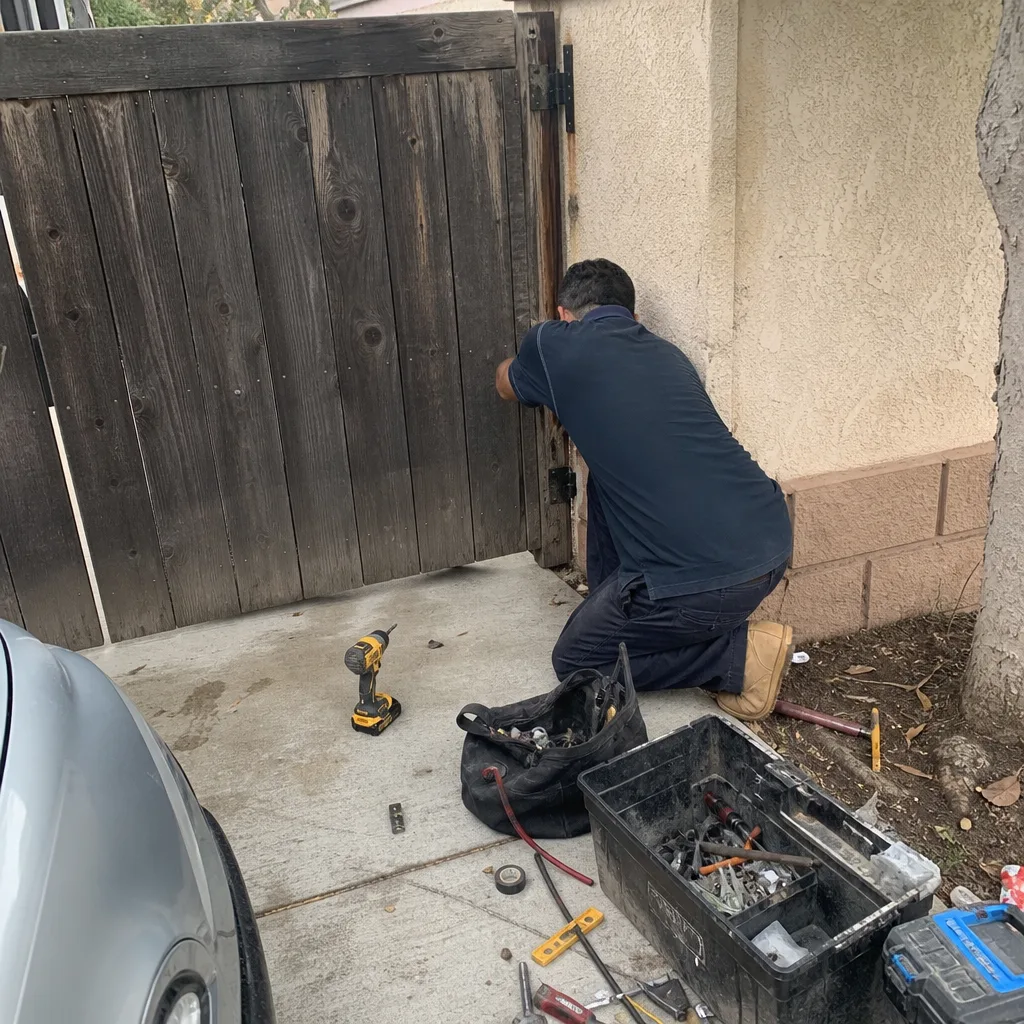 Before
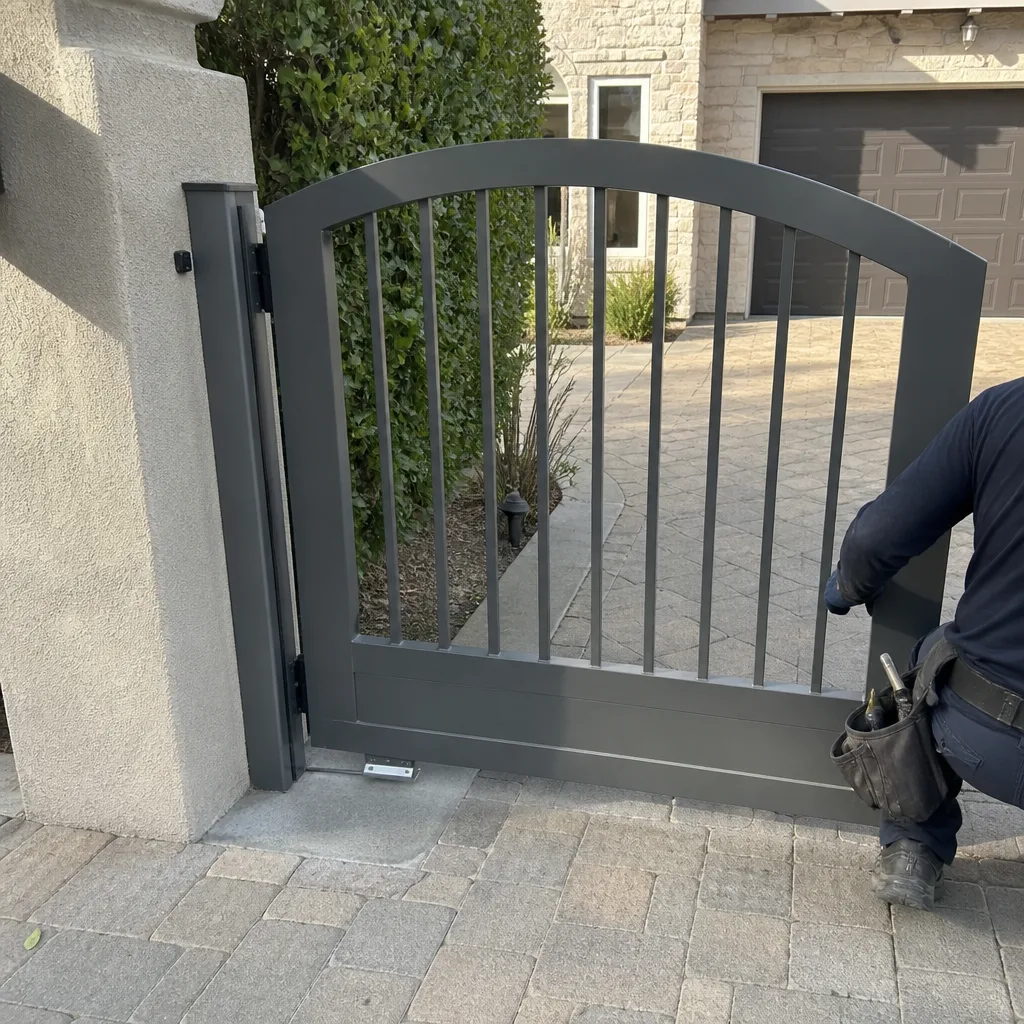 After
After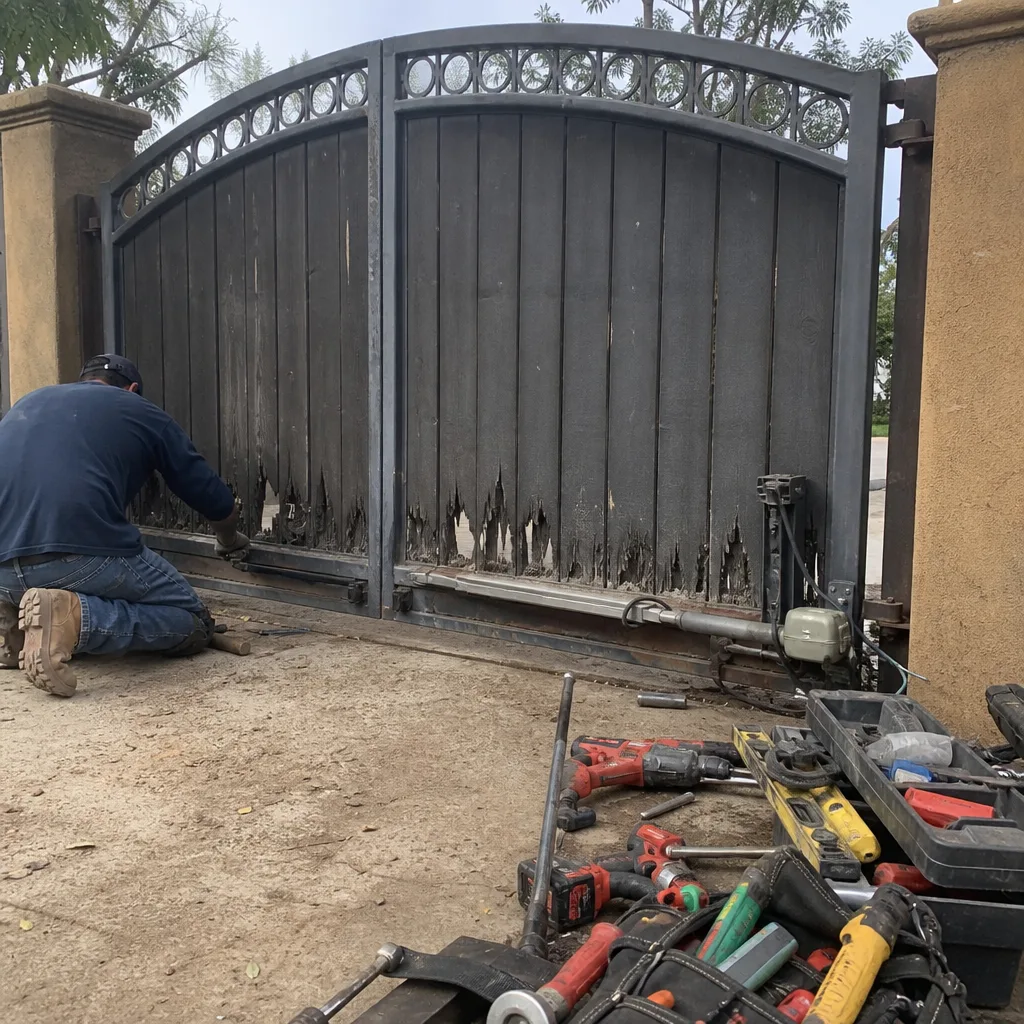 Before
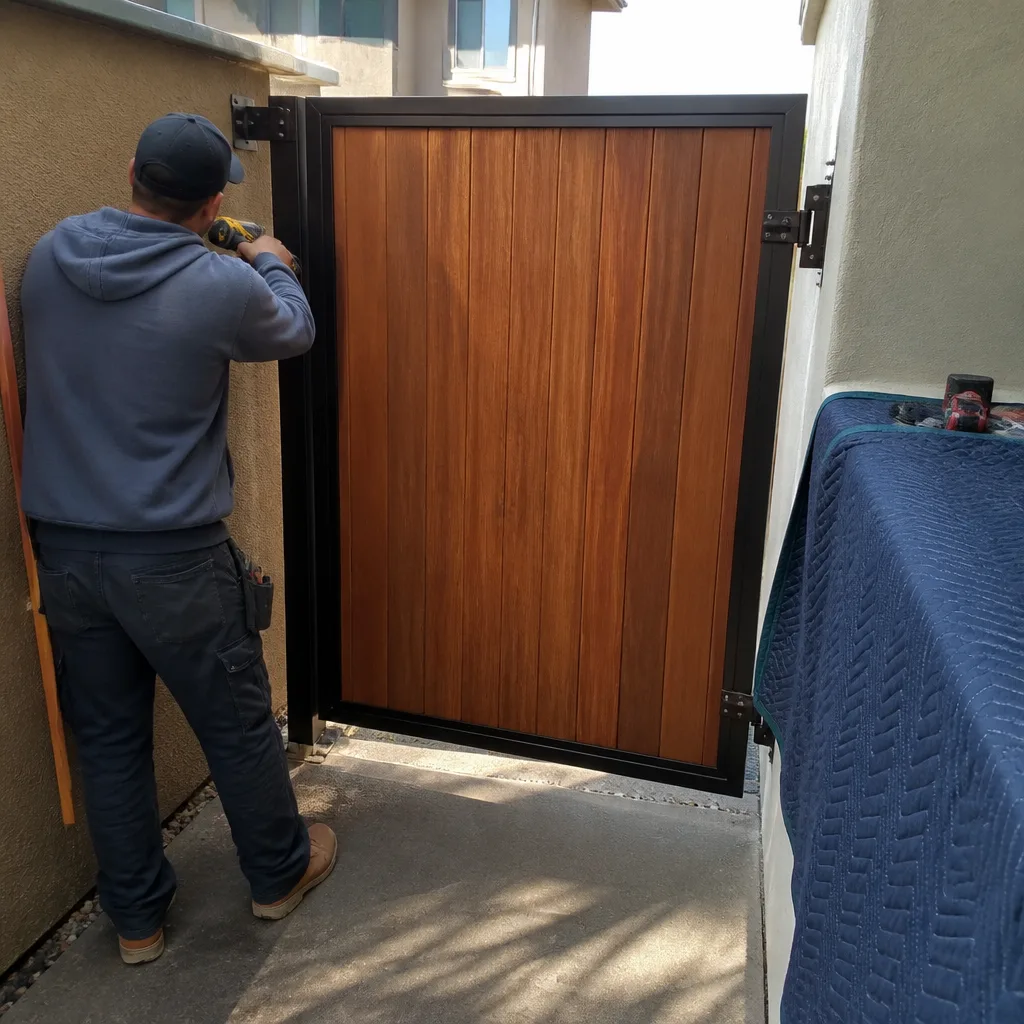 After
After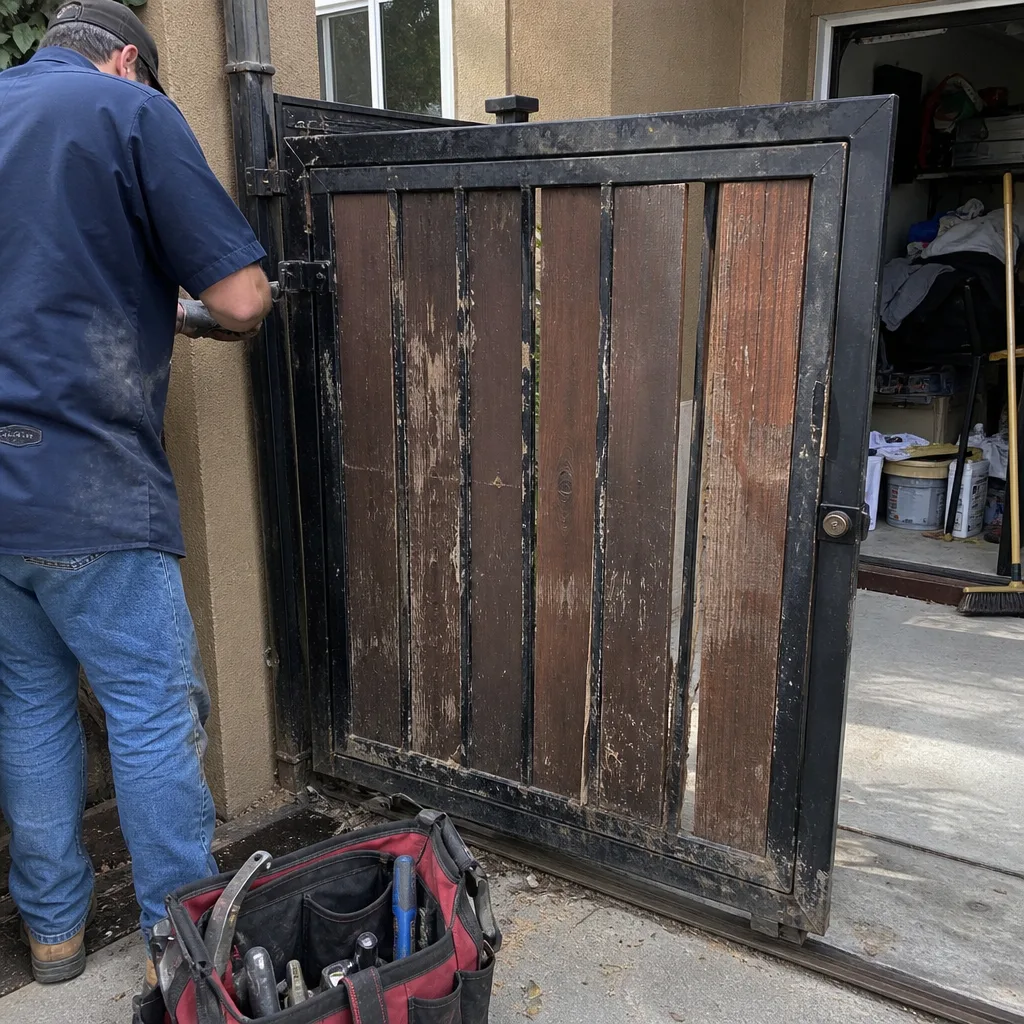 Before
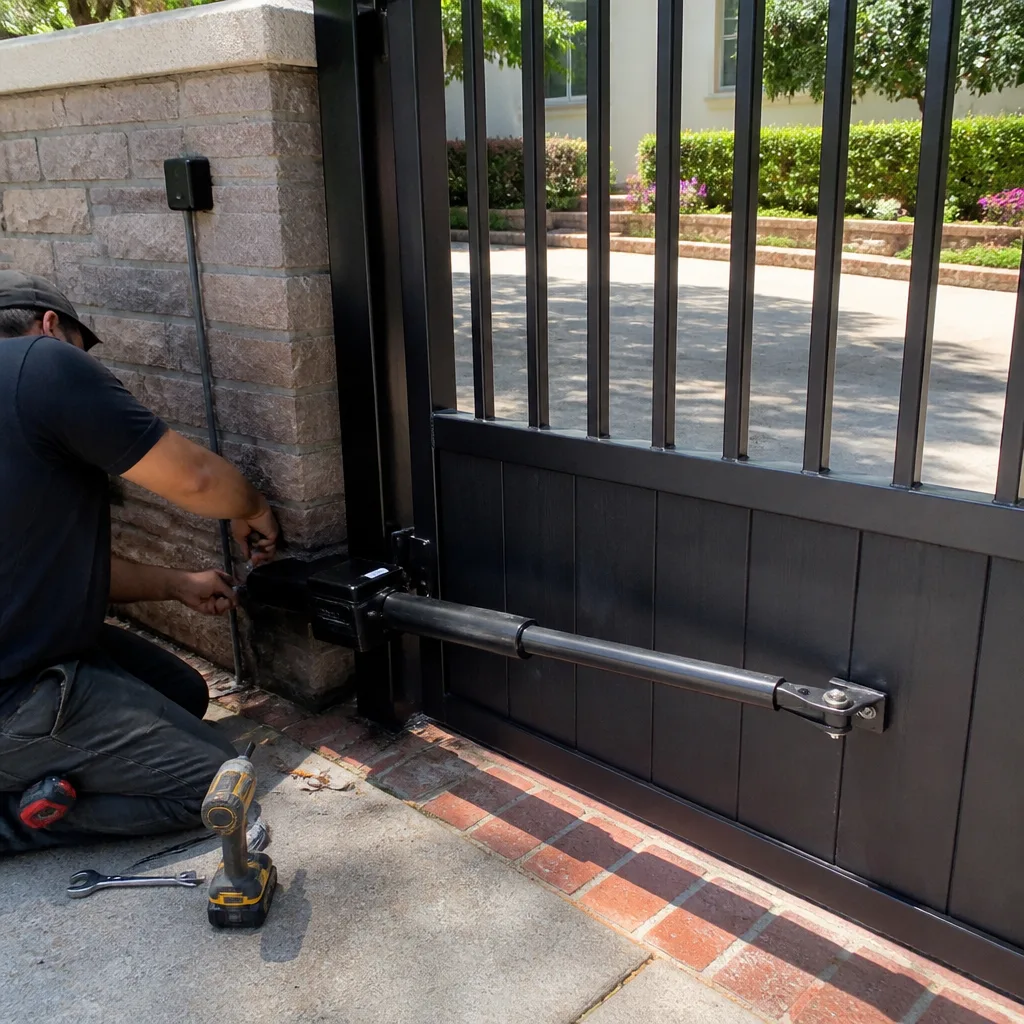 After
AfterDIY vs Professional Gate Repair: The Irvine Homeowner’s Decision Guide
Here’s a fact most Irvine homeowners don’t discover until it’s expensive: California doesn’t care how handy you are. It cares whether the work you performed meets the compliance standard a licensed contractor is legally required to document. You can adjust your own limit switches, clean your own tracks, and replace your own battery backup without tripping any legal threshold. You cannot install or substantially modify a gate operator without triggering UL 325 compliance requirements that only a licensed contractor can certify. Confusing those two categories is where DIY gate repair becomes a five-figure problem. This guide walks through the exact line between the two, task by task, so you can make the call with your eyes open. For related reading, see our Gate Repair Maintenance Checklist for Irvine Homeowners.
Quick Answer
DIY gate repair in Irvine is safe and legal for cosmetic and mechanical maintenance tasks: track cleaning, hinge lubrication, wheel replacement, sensor realignment, and battery swaps. It becomes legally and financially risky when the work touches the operator’s force settings, edge sensors, entrapment protection, or any electrical modification covered by UL 325. In California, those tasks require professional documentation that proves the gate meets entrapment-protection standards – and that’s the difference between a working gate and a liability you can’t defend in court.
Table of Contents
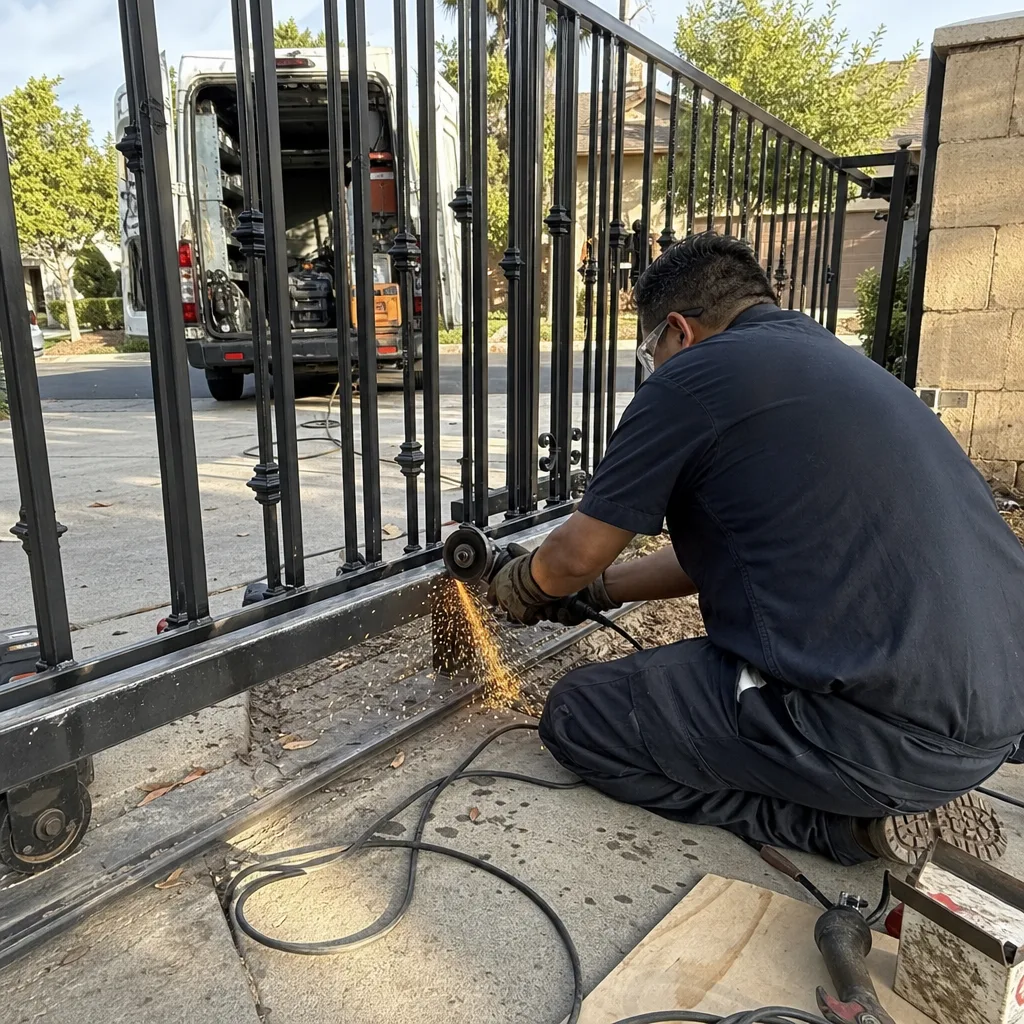
- The Real Line Between DIY and Professional Gate Repair
- Task-by-Task Matrix: What You Can Do, What You Can’t
- Why UL 325 Changes the DIY Conversation in California
- The Insurance Gap: What Your Policy Actually Says About DIY Gate Work
- Documentation: The Hidden Cost of an Undocumented DIY Repair
- How to Evaluate a Repair Video for California-Specific Accuracy
- Irvine’s Climate and Gates: What Local Conditions Do to Your Hardware
- Common Mistakes to Avoid
- When to Call a Professional
- Frequently Asked Questions
- The Bottom Line
BeforeAfterThe Real Line Between DIY and Professional Gate Repair
Let’s be precise about what changes when you touch a gate operator, because the law is precise about it. UL 325 is the Underwriters Laboratories standard that governs automated gate safety. It was written because gates have killed people – children in particular. When a gate closes on something it shouldn’t and the force isn’t set correctly, the result is entrapment. That’s the term the standard uses, and it’s the term your insurance company uses when it decides whether to pay a claim.
In California, a gate operator installed or modified without UL 325 compliance documentation is an unpermitted modification to a life-safety device. The consequence isn’t just a code violation. If someone is injured by that gate – a child, a delivery driver, a guest – the homeowner’s defense collapses. The question becomes: who last modified the entrapment protection, and did they document that the settings met the standard? A homeowner who changed a force setting and can’t produce documentation has no answer.
This is what most YouTube repair videos don’t tell you. They show you the bolt to turn. They don’t show you the force gauge you’re supposed to use to verify the setting afterwards, because that tool costs more than a service call. They don’t mention that Section 4.1 of UL 325 requires the installer to test and record the actual force the gate applies at the leading edge. They just show the adjustment and say “tighten it back up and you’re done.” You’re not done. You’re exposed.
We see the downstream effects in Irvine regularly. A homeowner disconnects a photo-eye because it kept faulting, decides to bypass it temporarily, and never reconnects it. Six months later the gate closes on a car. The insurance adjuster asks for the last service record. There isn’t one. That claim gets denied, and the homeowner is now personally liable for vehicle damage and whatever else follows.
The line isn’t about mechanical competence. A smart, careful homeowner can absolutely understand how a gate works. The line is about legal competence: the ability to prove the work met a national safety standard. That proof is what you’re buying when you hire a licensed contractor for our Gate Repair services. The labor and parts are secondary. The documentation is the product.
Task-by-Task Matrix: What You Can Do, What You Can’t
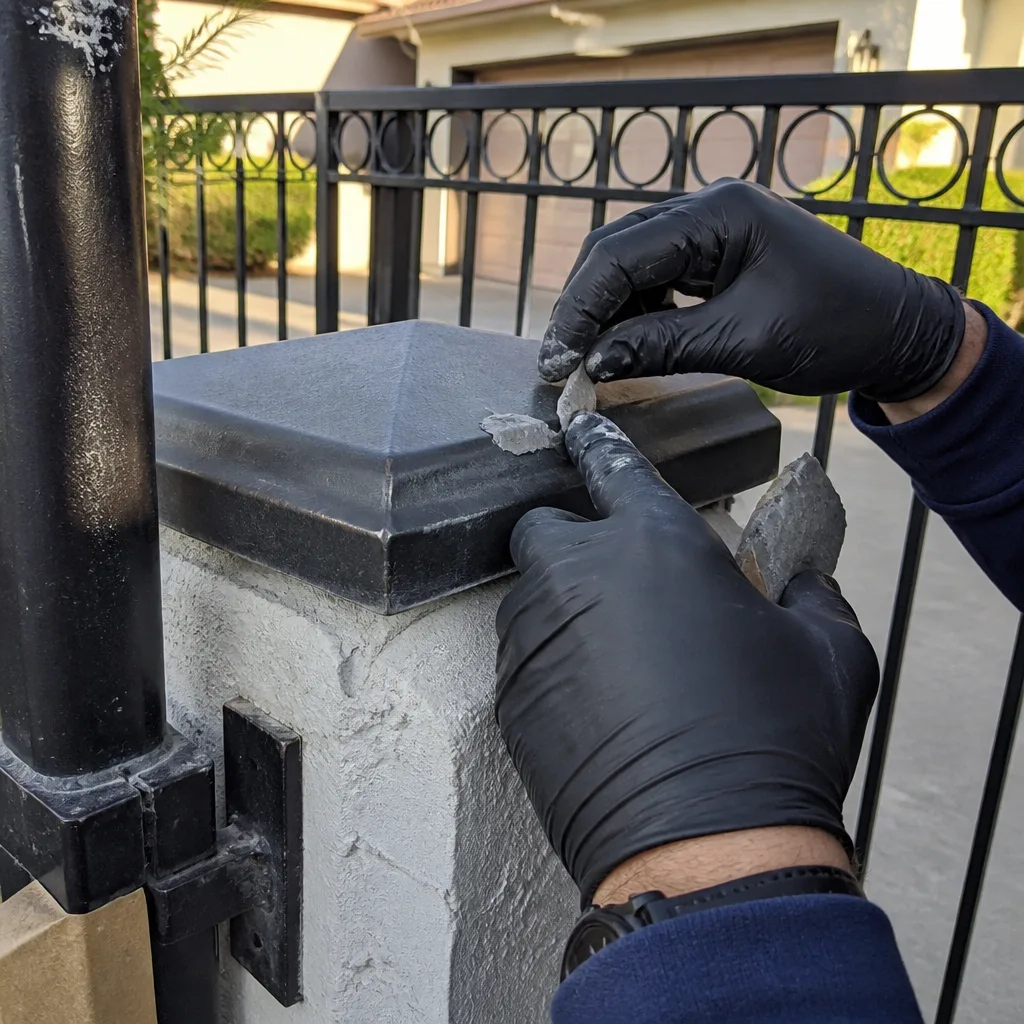
Here’s the breakdown, task by task, with the legal reality stated plainly. This isn’t a suggestion about skill level. It’s a statement of where California draws the line. If you’re in Irvine and you’re not sure which side a task falls on, err toward the professional side.
Safe and Legal for DIY
- Track cleaning and debris removal – Sand, leaves, and decomposed granite from Irvine landscaping accumulate in the track. Clearing it is maintenance, not modification.
- Hinge and wheel lubrication – A can of lithium grease and a rag. No electrical work, no settings, no compliance implications.
- Wheel or roller replacement – If the wheel is bolted on and accessible, swapping it is mechanical work similar to changing a tire. Document the part number you installed.
- Photo-eye realignment – If the beam is misaligned and you can see it’s not pointing at the reflector, adjusting the angle is fair game. If you’re replacing the unit, see below.
- Battery replacement in a battery backup unit – Disconnect power first, swap the battery, reconnect. The operator’s internal settings shouldn’t be affected by a battery change alone.
- Gate opener remote programming – Adding a new remote to an existing operator is a homeowner task. Most brands including LiftMaster and Mighty Mule have a learn button process that takes thirty seconds.
Professional Work Under California Law
- Operator installation or replacement – This triggers UL 325 compliance from scratch. Not a DIY task, period. The liability exposure begins the moment the operator is mounted.
- Force setting and entrapment protection adjustment – The settings that control how hard the gate pushes and when it reverses. This is the core of UL 325 and requires a force gauge to verify.
- Photo-eye and edge sensor replacement – Replacing a safety device changes the entrapment protection system. The new device must be tested and documented to meet the standard.
- Control board replacement or wiring modification – Any electrical change to the operator’s brain or its wiring. This isn’t about the difficulty of the solder joint. It’s that the result must be documented as compliant.
- Welding or structural repair to the gate frame – If the gate is cracked, sagging, or broken at a weld, the repair affects the gate’s weight, balance, and travel. A welded gate that’s out of square will destroy a new operator.
- Gate motor replacement – Even if you’re swapping like for like, the new motor must be set to the gate’s actual weight and travel. That’s a compliance task, not an assembly task.
For Irvine homeowners who want to understand what a full repair involves, our Gate Repair in Irvine page walks through the process from diagnosis to documentation.
Why UL 325 Changes the DIY Conversation in California
UL 325 exists because automated gates are powerful machines. A typical residential swing gate operator can apply hundreds of pounds of force at the leading edge. The standard was revised after the 1990s, when a series of child entrapment deaths forced the industry to face what happens when force settings are wrong. The standard now requires two independent forms of entrapment protection: inherent (the motor reverses when it senses resistance) and external (photo-eyes, edge sensors, or both).
The compliance steps that require professional documentation are specific and measurable:
- Force gauge testing at the leading edge and the hinge edge – The gate must not exceed the maximum force the standard allows at any point in its travel. A force gauge costs $300 and up. It’s the tool that produces the number, and the number goes in the record.
- Photo-eye and edge sensor function verification – Each safety device is tested individually. The test proves the gate reverses when the beam is broken or the edge is compressed, not just that the components are wired in.
- Travel and limit switch adjustment – The gate must stop and reverse at exactly the right points. Too far past travel and the operator strains against the frame. Too short and the gate doesn’t fully close.
- Warning signage placement – UL 325 requires specific warning signs on both sides of the gate. It’s the least exciting requirement and the most commonly skipped. It’s also the easiest thing for an insurance adjuster to photograph.
What’s notable about this list is that none of it requires special skill to understand. It requires tools and documentation. That’s the whole point. A careful homeowner could theoretically borrow a force gauge and learn to use it. But if the gate later fails and hurts someone, the homeowner must produce the record that proves the test was done. “I did it myself and wrote down the number” is not a legal defense in the way a licensed contractor’s documentation is.
This is why we say the DIY-versus-professional question isn’t about skill. It’s about evidence.
The Insurance Gap: What Your Policy Actually Says About DIY Gate Work
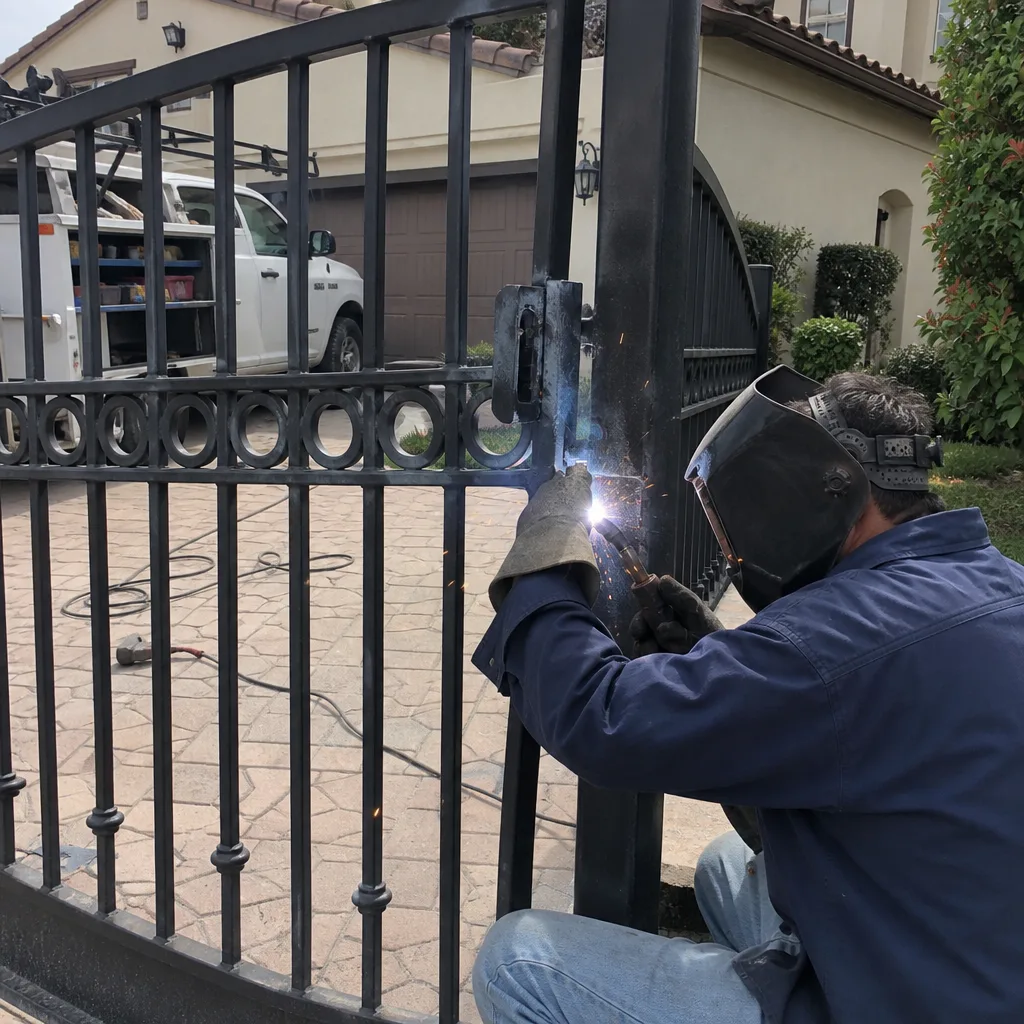
Homeowners insurance policies in California generally cover liability for injuries on the property. But most policies contain an exclusion or a coverage condition that applies to repairs performed by the homeowner on life-safety devices. The language varies by carrier, but the principle is consistent: if an injury is caused by a modification the homeowner made without professional certification, the carrier may deny the claim on the grounds that the homeowner assumed the risk.
Here’s what that looks like in practice. A homeowner in Irvine replaces a gate opener himself, following a video. He sets the force “so it closes firmly.” Three months later the gate closes on a neighbor’s child, who suffers a broken arm. The child’s parents sue. The insurance company’s adjuster inspects the gate and finds:
- No force gauge was used, so no force test record exists
- No photo-eye was installed, so only one form of entrapment protection existed
- No warning signage was in place
- The homeowner cannot produce documentation that any UL 325 compliance step was performed
The claim is denied. The homeowner is personally exposed. The medical bills, the legal fees, the settlement or judgment – all out of pocket. The $300 to $500 saved on the installation just became the worst financial decision of the homeowner’s life.
This isn’t a hypothetical. It’s a recurring pattern in the gate industry. The insurance companies know what UL 325 requires. They know what a compliant installation looks like. When the documentation isn’t there, they deny.
For homeowners who have already had a professional installation and are considering a DIY repair on the operator, the insurance reality is similar. The question isn’t whether you can do the repair. It’s whether you can defend the work if it fails. If you can’t produce a forced test record, you can’t.
Documentation: The Hidden Cost of an Undocumented DIY Repair
Here’s a scenario that doesn’t involve anyone getting hurt. You replace a limit switch yourself. You watch the video, you find the right part, you install it, the gate works. You’re proud. You saved $150. Six months later the gate starts acting up – it opens halfway and stops. You call a gate company in Irvine. The technician arrives, asks what was changed, and you say “I replaced the limit switch.” The technician asks which model. You don’t remember. The technician asks what the old one was set to. You didn’t record it. The technician now has to reverse-engineer your work to figure out what’s wrong.
That reverse-engineering takes time. The technician has to open the operator, inspect the wiring for changes, identify the switch you installed, check whether it’s the correct spec for that operator, verify the travel settings, and run through the diagnostics to isolate the fault. The time you saved on the DIY repair just got added back to your bill in diagnostic labor.
Now imagine the same scenario if you had documented the work. You took a photo of the old switch before you removed it. You wrote down the part number of the new one. You noted the wiring connections you made. You left that note inside the operator cover. The next technician reads the note, sees exactly what was changed, and goes straight to the diagnostic. The repair is faster, the bill is lower, and the technician isn’t guessing.
What should a DIY repair document, even when the work is legal?
- Photos of the component before removal, from multiple angles
- The exact part number installed, from the package or the part itself
- A note describing what was removed and what was installed, including wire colors and terminal positions
- The date the work was done
- Any settings that were changed and their new values
This is what we mean by documentation. It’s not bureaucracy. It’s the difference between a future repair that costs $150 and one that costs $400 because the technician has to reconstruct the history you didn’t record.
Our team at Vance Gate Repair Irvine does this on every visit as a matter of habit. You can also find more guides & resources on our blog. That’s the origin of our approach – commercial access-control work requires a paper trail, and we saw no reason residential gates shouldn’t have one. When we leave a job in Irvine, the homeowner gets a photo log of what was found, what was changed, and what was installed. If another company takes over next year, they won’t have to guess.
How to Evaluate a Repair Video for California-Specific Accuracy
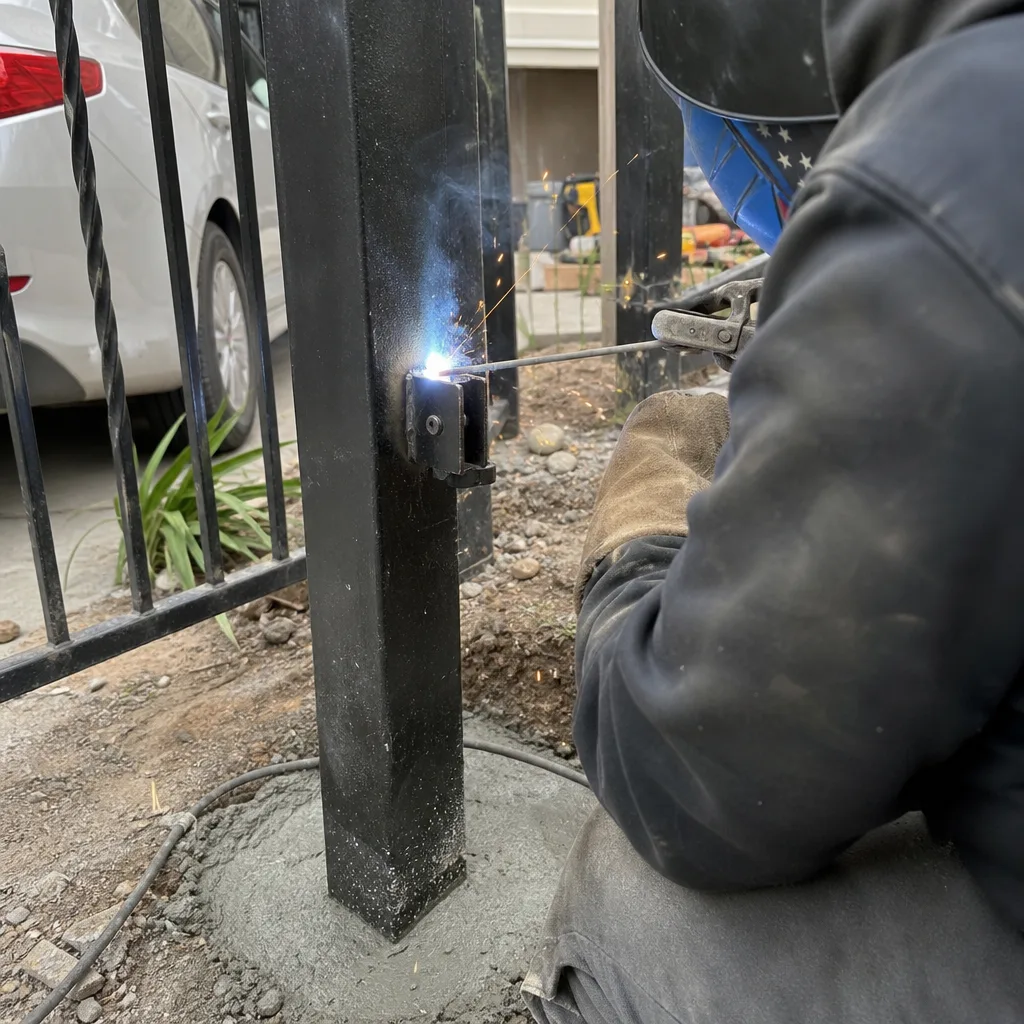
The internet is full of gate repair tutorials. Some are excellent. Some are dangerous. The problem is that most are filmed by people in other states, and gate regulations are not uniform across the country. California adopted UL 325 as the operative standard for automated gates, and Irvine’s enforcement is consistent with that. A video filmed in Texas may show a procedure that’s entirely legal in Texas and entirely non-compliant in California.
Here’s how to evaluate a repair video before you follow it:
- Check the narrator’s disclosures. Does the video mention UL 325 at all? Does it mention force testing, entrapment protection, or compliance? If the word “compliance” never appears, the video is a mechanical tutorial, not a legal one. Follow it at your own risk.
- Look for force-setting instructions. A video that says “set the force so the gate closes firmly” is telling you to adjust a safety setting without measuring it. That’s the biggest red flag in DIY gate content. A legitimate professional would never adjust force without a gauge.
- Check the date. UL 325 was significantly revised in the 2000s and again after. A video from 2013 may show procedures that are no longer compliant. The standard evolves, and old videos don’t update themselves.
- Look for the warning signage step. It’s boring, but it’s required. If a video shows a full operator installation and never mentions signage, the creator doesn’t know the standard. The rest of the video is suspect.
- Check the comments for corrections. If the video has a technical error, someone usually points it out. Read the top comments before you pick up a wrench.
For Irvine homeowners specifically, there’s an additional consideration. Irvine has a lot of gate automation on Del Mar, in the Great Park neighborhoods, in Woodbridge, University Park, and Turtle Rock. The operators are typically from the major brands: DoorKing and Elite are common on older installations, LiftMaster on newer ones. A repair video that covers a brand you don’t have is only useful in proportion to how similar the designs are. Before you follow a video, confirm it covers your specific operator model, not just the brand. A LiftMaster LA400 is not the same as a LiftMaster LA500, even though they share a logo.
If the video skips documentation steps, skips compliance, or is ambiguous about force settings, that’s your signal to put down the screwdriver and make a call.
Irvine’s Climate and Gates: What Local Conditions Do to Your Hardware
Irvine’s climate is relatively kind to gate hardware compared to coastal or mountain communities. We don’t get the salt air of Newport or the freeze-thaw cycles of Big Bear. But we do get three things that matter for gate longevity: dust, heat, and irrigation.
Dust is the quiet killer. Irvine’s dry summers and the decomposed granite used in many landscape designs produce fine particulate that works its way into hinges, wheels, tracks, and the operator’s internal components. Over time, dust acts as an abrasive. A gate that’s never cleaned will wear its wheels unevenly and start to drag. A dragging gate makes the operator work harder. An overworked operator fails sooner. In neighborhoods like Northwood and Woodbridge, where gates have been in service for fifteen or twenty years, we see dust accumulation as a primary factor in premature operator failure.
Heat is the second factor. Irvine regularly sees summer temperatures in the 90s, and gate operator enclosures sitting in direct sun can exceed 140 degrees internally. That heat accelerates the degradation of capacitors and other electronic components on the control board. It also softens lubricants, causing them to run off rather than stay in place. A gate that’s fine in March may fail in August, not because anything changed mechanically, but because a capacitor finally gave out under heat stress.
Irrigation overspray is the third factor, and it’s more common than most Irvine homeowners realize. Sprinkler systems near driveway gates often wet the operator or the track. Repeated wetting and drying cycles cause corrosion on electrical connections and rust on steel components. We see this regularly in neighborhoods with mature landscaping, where the sprinkler pattern changed over time as plants grew and now hits the gate.
All three factors are maintenance issues, and maintenance is DIY territory for the most part. You can clean your tracks, wipe down your operator housing, redirect a sprinkler head, and relubricate your hinges. What you can’t do is repair the damage those factors cause when they’re ignored: burned-out control boards, seized motors, and warped gates. That’s where the line between maintenance and repair starts to matter.
For a deeper look at the repair side, our Vance Gate Repair Irvine home page covers the full range of what we see and fix across Irvine.
Common Mistakes to Avoid
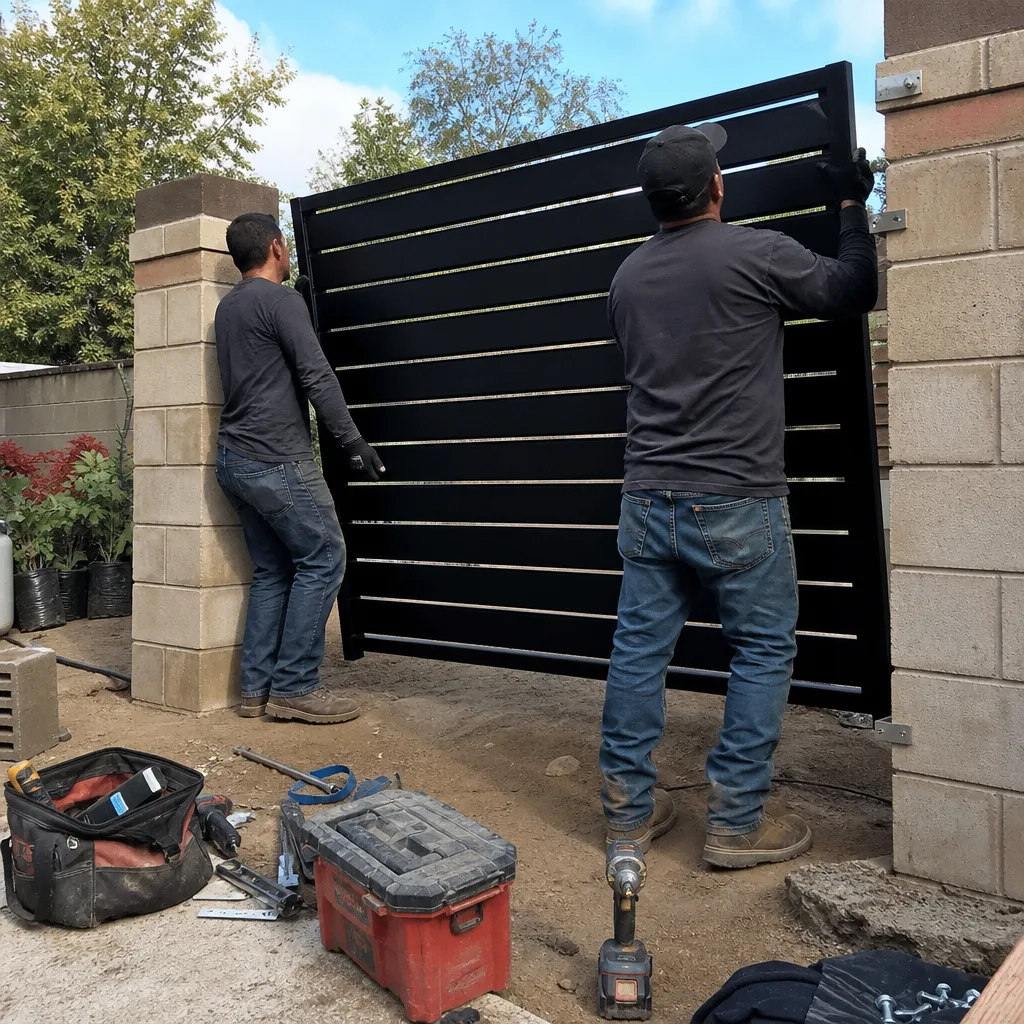
- Adjusting force settings without a gauge. The single most dangerous DIY gate mistake in Irvine. The setting that “feels right” is almost always too high, and the homeowner has created an entrapment hazard without a record of the change.
- Disconnecting a photo-eye instead of realigning it. A photo-eye that keeps faulting usually needs alignment or cleaning. Disconnecting it removes an entire layer of entrapment protection and creates a liability exposure the homeowner can’t document.
- Following a repair video for the wrong operator model. Even within the same brand, models differ. A DoorKing 9150 and a DoorKing 9154 are not interchangeable in their wiring or programming. The video for one will mislead you on the other.
- Skipping the documentation step. The DIY repair works, so the homeowner thinks the job is done. Six months later, a technician has to reverse-engineer what was changed. That time shows up on the next bill.
- Using the wrong lubricant. WD-40 is not a gate lubricant. It’s a solvent. It strips the existing lubricant and leaves the hinge dry. Use a white lithium grease or a dedicated gate hinge lubricant instead.
- Welding a cracked gate without addressing the cause. If a gate cracks, something overloaded it. Welding the crack without finding the underlying cause – a bad wheel, a shifted post, an unbalanced gate – means the crack will return, usually next to the weld.
- Assuming a new opener will work with an old gate. An opener sized for a 400-pound gate installed on a 600-pound gate fails prematurely. The operator has to be matched to the gate’s actual weight and travel, not the homeowner’s guess.
When to Call a Professional
Call a gate professional when the repair touches the operator’s safety systems: force settings, photo-eyes, edge sensors, or anything involving the control board. Call when the gate is showing signs of structural trouble: sagging, cracking, grinding, or binding. Call when the repair involves electrical work you can’t document as compliant. Call when you’ve already tried the DIY fix and the gate is still misbehaving. You’re not failing by calling. You’re making the same decision a careful business owner makes when the liability outweighs the savings. Vance Gate Repair Irvine offers free estimates throughout Irvine – call (657) 258-2588 and we’ll give you a written price before any work starts.
Frequently Asked Questions
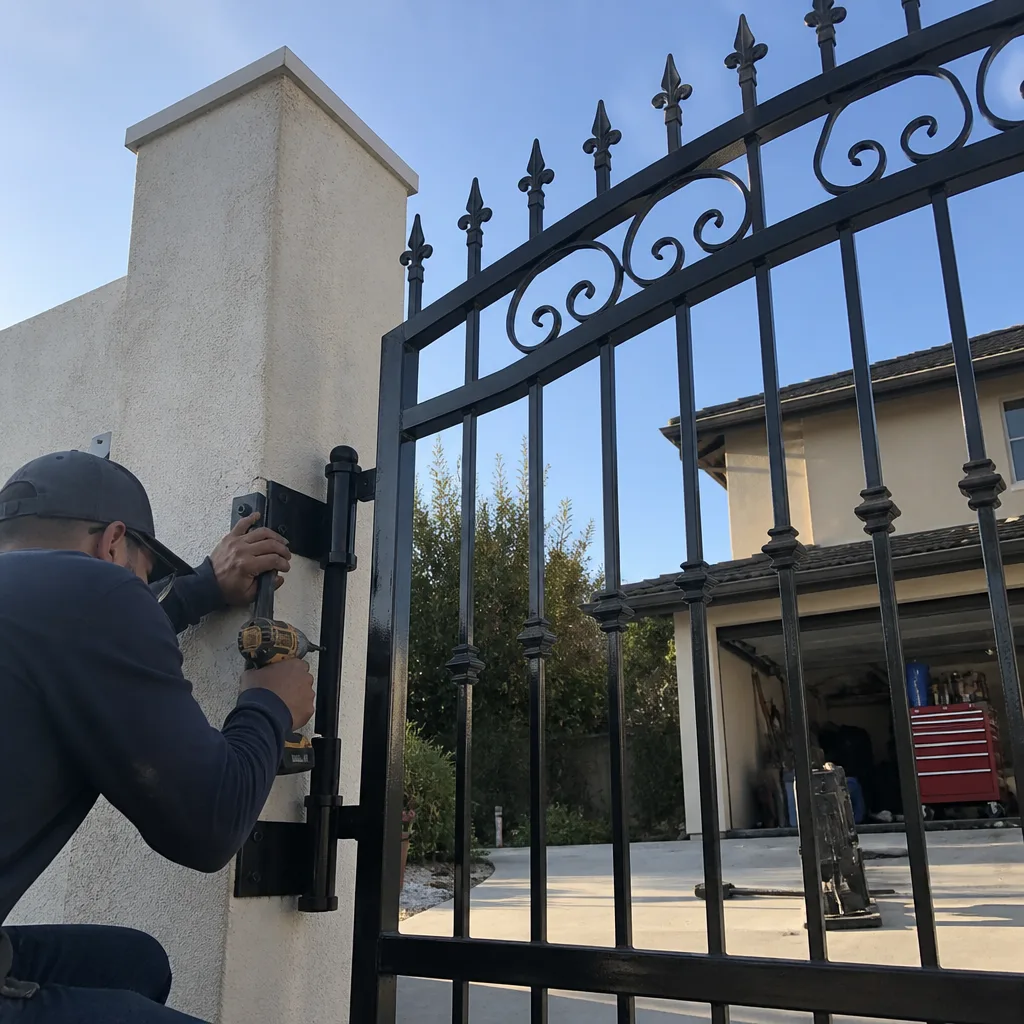
You can legally perform maintenance tasks like cleaning, lubrication, wheel replacement, and remote programming on your own gate opener in Irvine. You cannot install or modify an operator’s safety systems – force settings, photo-eyes, edge sensors, or control board wiring – without triggering UL 325 compliance requirements that require professional documentation. Doing so creates a liability exposure your insurance company may not cover.
UL 325 is the Underwriters Laboratories standard that governs automated gate safety, specifically entrapment protection. It requires gate operators to have working force settings, external safety devices like photo-eyes or edge sensors, and warning signage, all verified and documented. In California, a gate that doesn’t meet UL 325 is an unpermitted life-safety modification, and injuries caused by that gate are likely to fall outside your insurance coverage.
Professional gate repair in Irvine typically runs between $150 and $600 depending on the scope. A photo-eye realignment or limit switch adjustment is usually at the low end. A control board replacement or motor swap is at the high end. The exact price depends on the operator brand, the gate’s condition, and what’s actually wrong. Vance Gate Repair Irvine provides a written price before any work begins, so you know the number up front.
We service nine automation brands including DoorKing, LiftMaster, Elite, Mighty Mule, and others. We work on whatever motor is already on your property rather than steering you toward a replacement. If you’re not sure what brand you have, we’ll identify it during the diagnosis and give you the written price for the repair.
A DIY repair on the operator’s safety systems can create a basis for your insurance company to deny a liability claim if someone is injured by the gate. The policy language varies, but the principle is consistent: unprofessional modifications to life-safety devices are often treated as homeowner-assumed risk. Documented compliance is what protects you, and that’s what professional gate service provides.
Call us. A live person answers the phone 24 hours a day, seven days a week at Vance Gate Repair Irvine. Gates that fail at night are often a security issue – an open gate or a gate stuck in the closed position blocking your driveway. We’ll assess the situation over the phone and dispatch a technician if needed. Call (657) 258-2588 any hour.
The Bottom Line
The DIY-versus-professional question for gate repair in Irvine isn’t about whether you’re handy enough. It’s about whether the task carries legal or liability exposure that makes amateur completion risky. Maintenance tasks like cleaning, lubricating, and wheel replacement are safe to self-perform. Operator work – force settings, safety devices, wiring, or installation – crosses into compliance territory where documentation is the product. If you’re not sure which side of the line a job falls on, the safest call is to get a written price from a professional. At minimum, document whatever work you do perform. A photo and a note in the operator cover will save the next technician time and save you money.
For gate motor service, gate motor & opener in Irvine covers operator diagnostics and repair in detail. If you’re weighing repair against replacement, gate installation in Irvine walks through the decision. And if you want a professional assessment, call us at (657) 258-2588 – the estimate is free, and it’s in writing before you decide anything.
Written by Adrian Vance, Owner at Vance Gate Repair Irvine, serving Irvine since 2014.