
Last updated September 20, 2026
Free on-site gate assessment - hinges, posts, and your LiftMaster or Nice gate operator checked before anything is quoted
The assessment is free and the quote is the invoice.

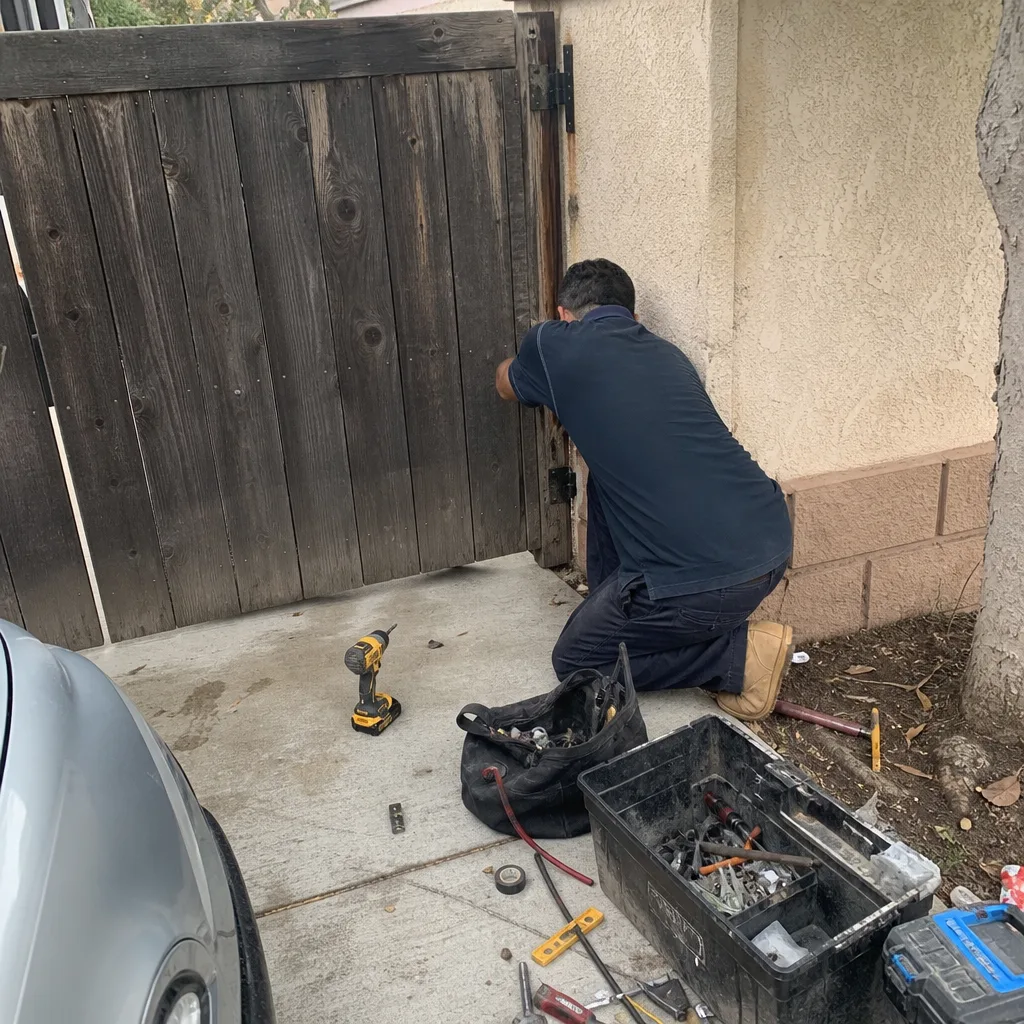 Before
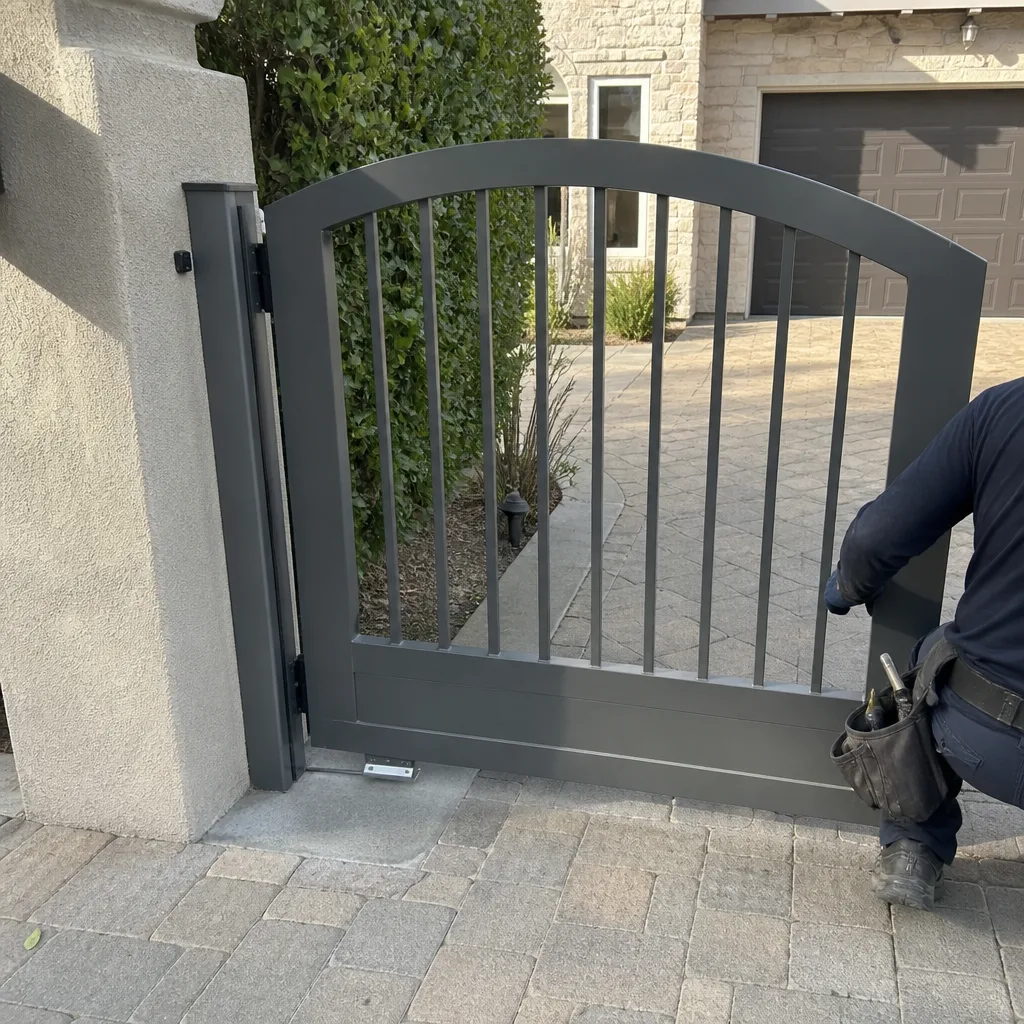 After
After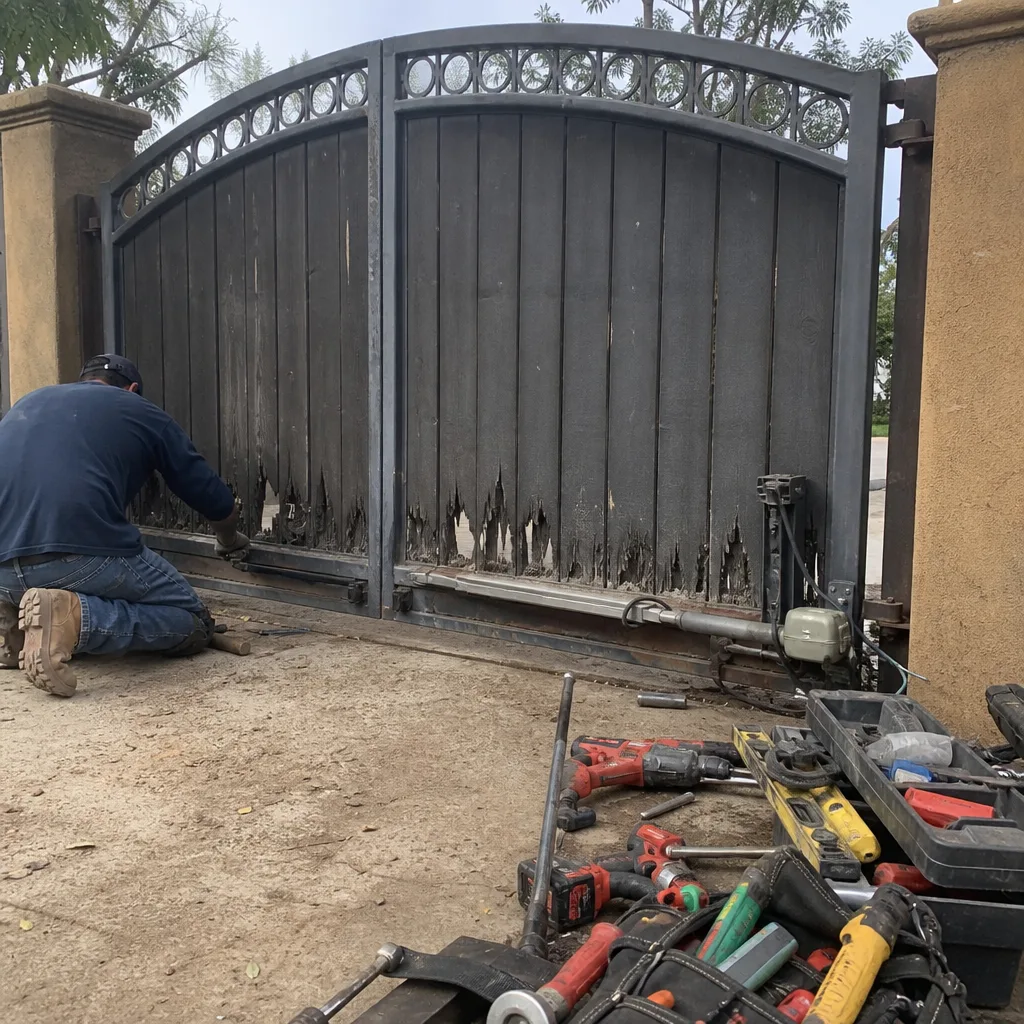 Before
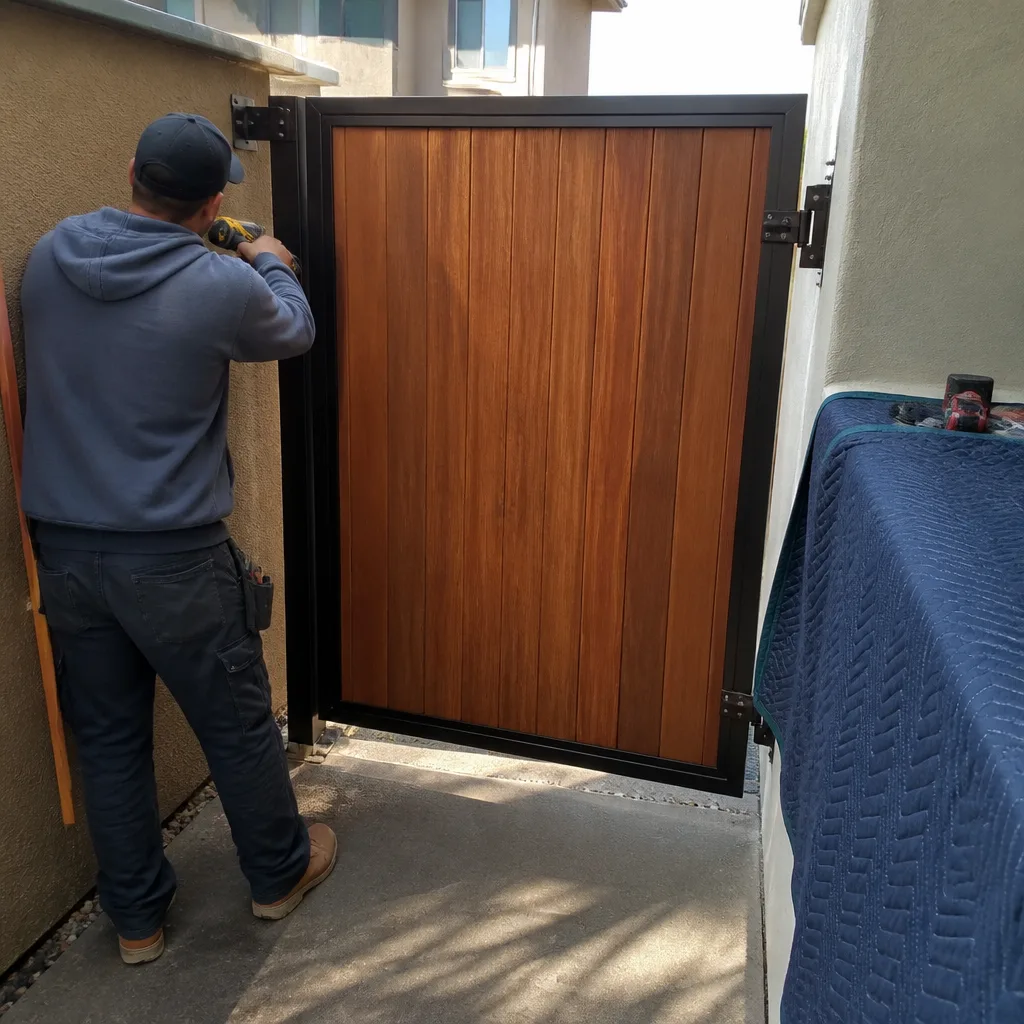 After
After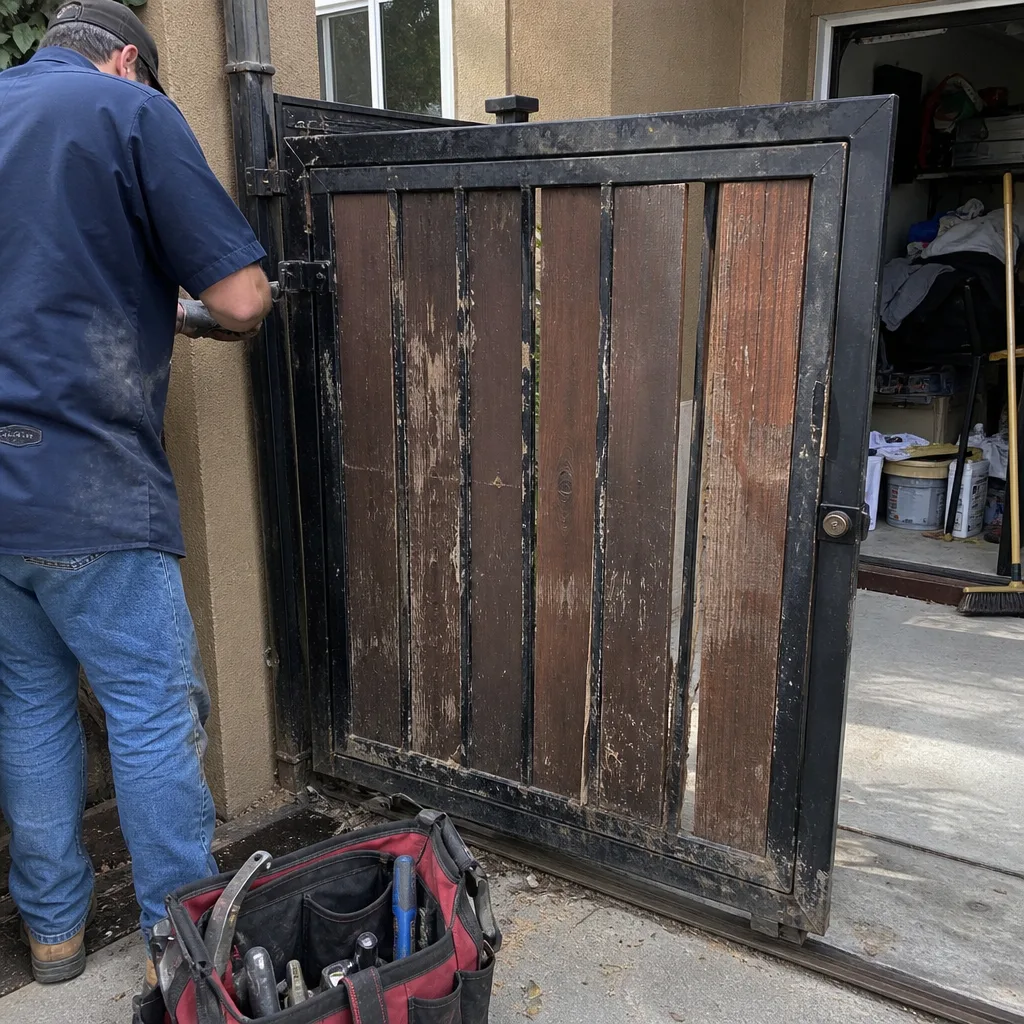 Before
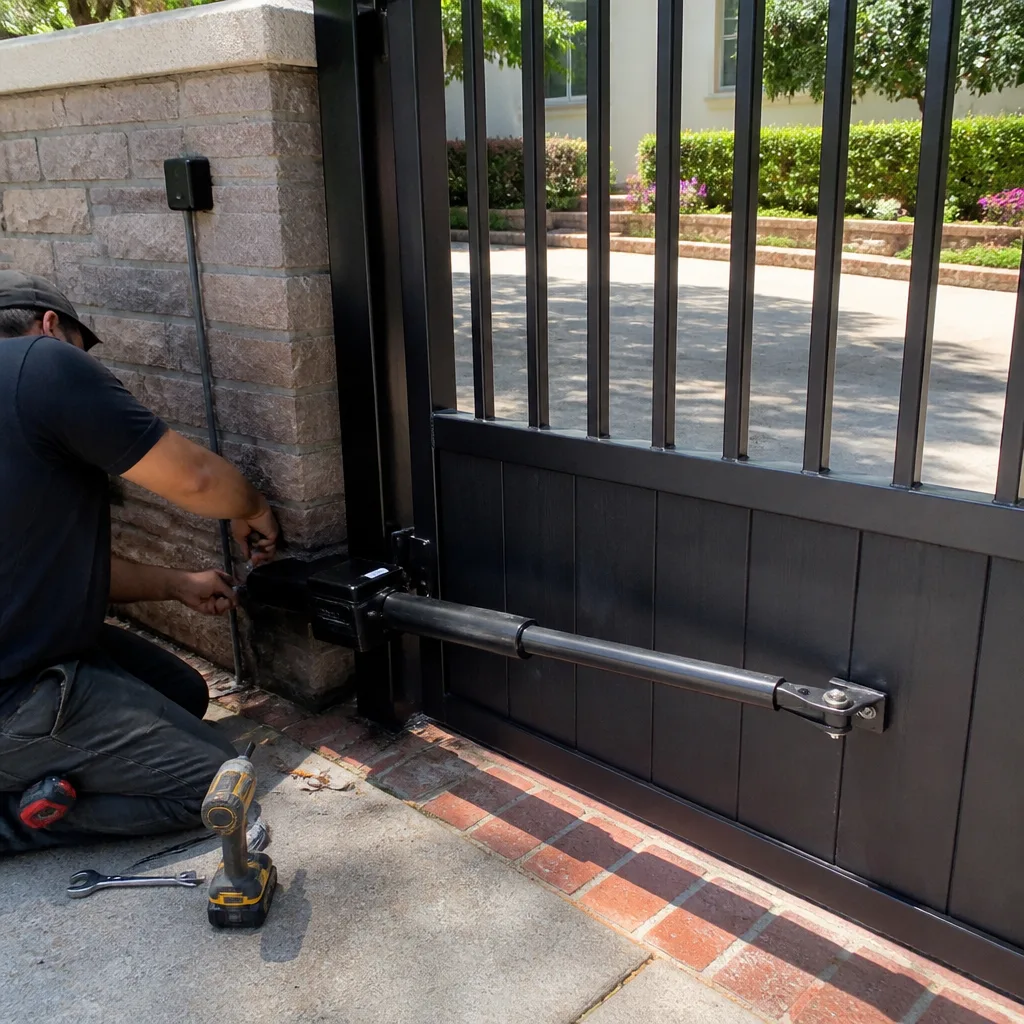 After
AfterGate Repair Warning Signs: A Irvine Homeowner’s Reference Guide
A gate that hesitates for two seconds before moving is not a gate with a slow motor. It’s a gate whose operator is drawing excess current to overcome a mechanical problem, and that distinction costs roughly $400 to ignore. In Irvine, where driveway gates run hundreds of open-close cycles per month and sit exposed to coastal sun and alkaline dust, the gap between a $90 hinge adjustment and a $1,400 motor replacement is usually measured in weeks of neglected warning signs. This guide gives you the reference we wish every homeowner had before they called us for our Gate Repair services: what failure sounds like, what it measures like, and how to document it so no contractor can inflate the diagnosis.
Quick Answer
Gate repair warning signs in Irvine fall into five component categories: operator, hinge, track, controller, and safety devices. The threshold between “monitor it” and “fix it now” is measurable in most cases: a gate taking more than 15 seconds to travel its full arc, a motor housing exceeding 140°F after five cycles, or a 2-inch gap between a photo-eye beam and its receiver all warrant same-week service. If you hear relay chattering (a rapid clicking from the control board), shut the gate off at the breaker and call a professional before the board takes the transformer with it.
Table of Contents
- Operator Warning Signs: What the Motor Is Telling You
- Hinge and Structure: The Components That Kill Operators
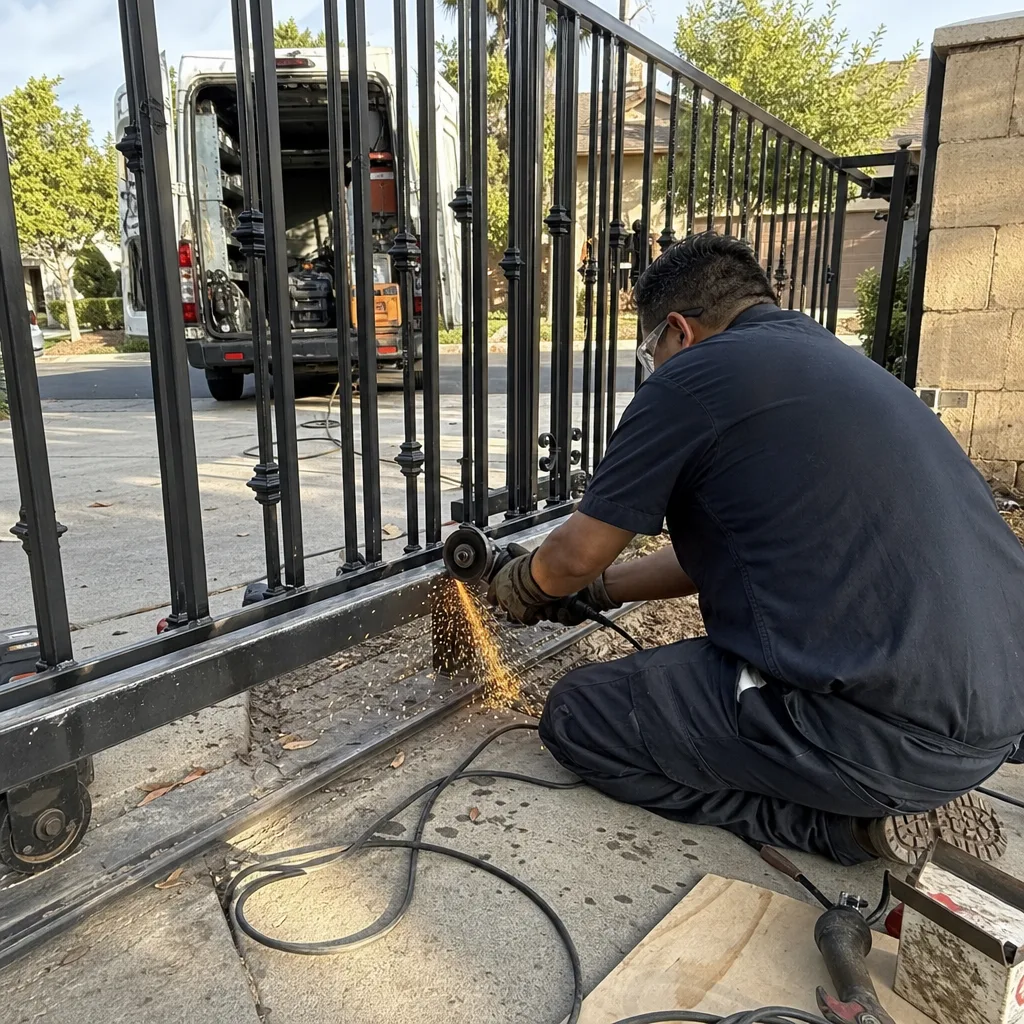
- Track and Roller Warning Signs on Sliding Gates
- Controller and Electrical: Warning Signs You Hear, Not See
- Safety Device Warning Signs: Photo-Eyes, Edges, and Loops
- The Three Warning Signs Irvine Homeowners Dismiss as Normal
- Photo Documentation Protocol: Baseline Evidence Before the Technician Arrives
- Common Mistakes to Avoid
- When to Call a Professional
- Frequently Asked Questions
BeforeAfterOperator Warning Signs: What the Motor Is Telling You
Most residential gate operators in Irvine are electromechanical: a motor drives a gearbox that turns an arm or a sprocket. When a component downstream starts binding, the motor draws more current to compensate. That extra current shows up as heat, and heat is what kills the motor windings or the start capacitor. So the warning signs are almost always indirect: you notice the symptom of excess draw long before the motor fails outright.
Here are the specific thresholds we use in the field to separate “monitor it” from “fix it now”:
- Travel time over 15 seconds. A well-tuned single swing gate in Irvine should travel its full arc in 10 to 14 seconds under normal load. If a gate that once opened in 12 seconds now takes 18, that’s not wear. That’s a mechanical bind transferring load to the motor.
- Motor housing above 140°F after five consecutive cycles. Run the gate open-close five times, then put the back of your hand on the motor housing (carefully, if you suspect it’s hot). If it’s too hot to hold comfortably for five seconds, the operator is working beyond its duty rating. Call before the thermal overload trip becomes permanent.
- Burn odor near the operator after a single cycle. Electrical varnish has a distinct smell, sharp and stale at once. One cycle should not produce it. If it does, the start capacitor or the windings are already degrading.
- Gate slows noticeably in the middle third of travel. Motors run at constant speed. If the gate moves fine for the first few feet, then labors, then speeds up near the end, that’s a mechanical obstruction midline; the motor is fighting it. On swing gates we often find a sagging hinge pin at that exact position.
We service nine automation brands, including DoorKing, Elite, and Mighty Mule operators that are common in Irvine’s older tract developments. The warning signs don’t change by brand. A DoorKing 9150 drawing high current on a Northwood swing gate fails the same way a Mighty Mule in Woodbridge does. What varies is the cost to ignore it. A gate motor replacement in Irvine runs between $800 and $1,800 installed depending on brand and arm configuration. Most of those replacements could have been avoided with a $120 hinge service three months earlier.
Hinge and Structure: The Components That Kill Operators
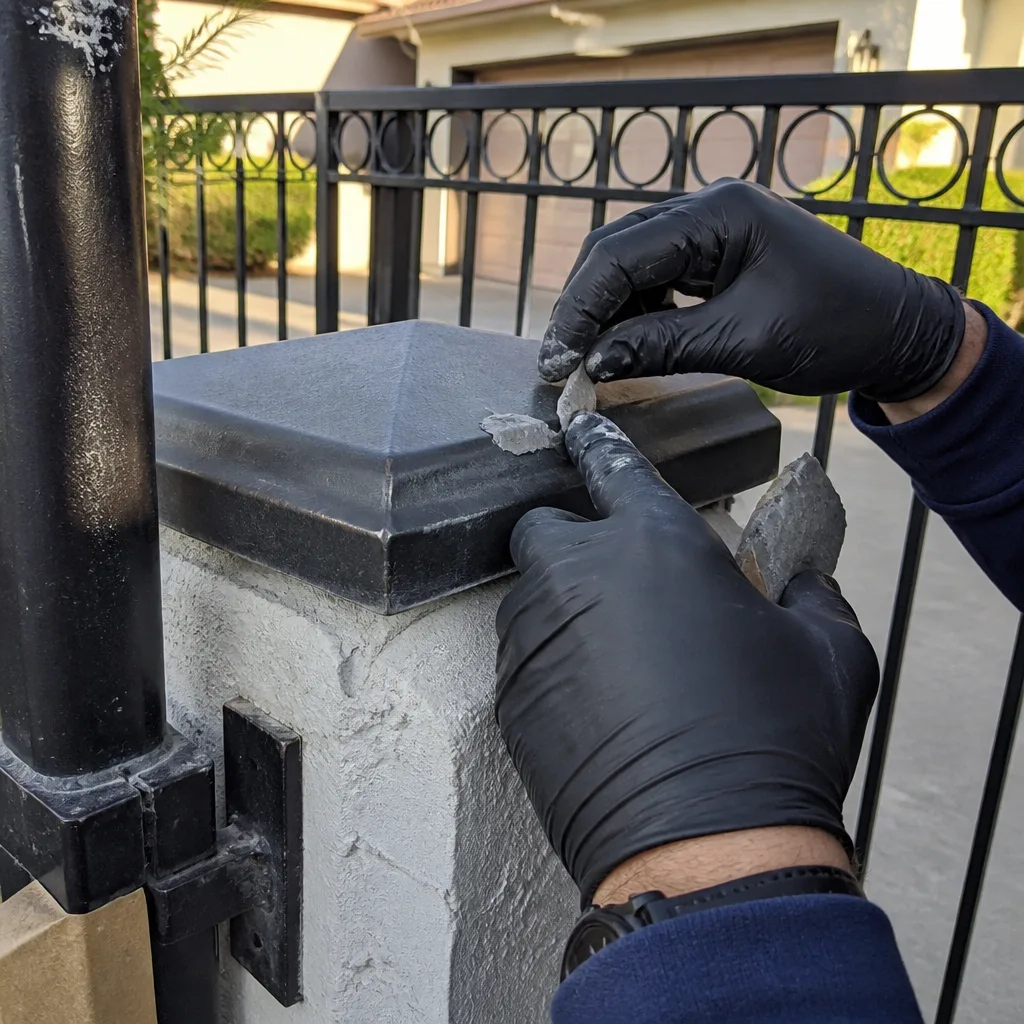
We’ve replaced motors where the motor was the victim, not the culprit. The operator was fine. The gate had sagged a quarter-inch on the hinge side, and that quarter-inch was enough to make the motor work against gravity on every cycle. In Irvine’s dry climate, steel posts set in concrete stay put, but the gate leaf itself is usually a hollow steel or aluminum frame holding a wood or composite infill. That infill absorbs moisture differently than the frame, and the differential expansion works hinge pins loose over a few seasons.
What to look for and how to measure it:
- Sight the gap between the gate leaf and the post. At the hinge side, the gap should be consistent top to bottom. If the top gap is 3/8 inch and the bottom is 5/8 inch, the gate has sagged roughly a quarter-inch. That’s the threshold where the motor begins compensating.
- Lift the gate at the latch side. With the gate closed and the operator disengaged (usually a release handle on the arm or the operator), try to lift the free end. Any vertical movement over 1/8 inch means the hinge bushings are wearing, not the hinge bodies. Bushings are a $40 fix. Letting them go destroys the hinge bodies, which means cutting and welding.
- Watch the latch engagement as the gate closes. If the latch now catches on the lower edge of the receiver or scuffs against the strike plate, the gate has shifted. That scuffing is the first mechanical drag the motor notices.
- Check the post for movement. Put your hand on the post and cycle the gate. If you feel vibration traveling through the post, the post base has lost purchase, usually because the concrete pour was shallow or the rebar cage was skimped. This is the most expensive structural fix, and the earlier it’s caught, the cheaper the remediation.
In our experience across Irvine’s neighborhoods, hinge neglect is the single most common cause of avoidable operator failure. It’s also the repair contractors underdiagnose most often, because diagnosing it requires taking a measurement, not just looking at the gate. Gate repair in Irvine that starts with hinge measurements, not a motor swap, usually ends with a smaller invoice and a longer service interval.
Track and Roller Warning Signs on Sliding Gates
Sliding gates in Irvine run on one of two systems: a ground track with V-groove rollers, or a cantilever design that rides on rollers mounted to posts with no ground contact. The ground-track style is more common in Irvine’s equestrian-zoned properties in Shady Canyon and the older ranch-style lots along Santiago Canyon Road, where horizontal clearance favors a slide over a swing.
The warning signs for a sliding gate are more audible than visual:
- A rhythmic thump as the gate travels. That’s a flat-spotted or chipped roller. Each revolution produces one thump. The roller is no longer rolling; it’s being dragged. A $38 roller replacement becomes a $400 track repair if the flat spot gouges the track.
- Steel-on-steel grinding. This is different from a thump. A constant grinding means the roller bearing has seized. The wheel is sliding along the track, not rotating. At this point the track is being machined down every cycle.
- Gate climbs the track at one end. If the gate rises slightly as it opens and then drops as it closes, one roller is worn more than the others, or the track has developed a low spot. The gate is running downhill into a hole every time it opens.
- Debris accumulation at the track. Irvine’s eucalyptus-lined streets dump leaves, bark strips, and seed pods into gate tracks constantly. If the track has debris compacted at the ends, the gate is slamming debris into the end stops, which transfers shock through the chain or belt into the gearbox.
One measurement separates a track problem from an operator problem: the amp draw at the motor during travel. A healthy sliding gate draws roughly 4 to 6 amps at 12 volts DC or 2 to 3 amps at 120 volts AC depending on weight. A gate with a seized roller can draw double that. If you don’t have a clamp meter, the temperature test from the operator section gets you the same answer without the electrical work.
Controller and Electrical: Warning Signs You Hear, Not See
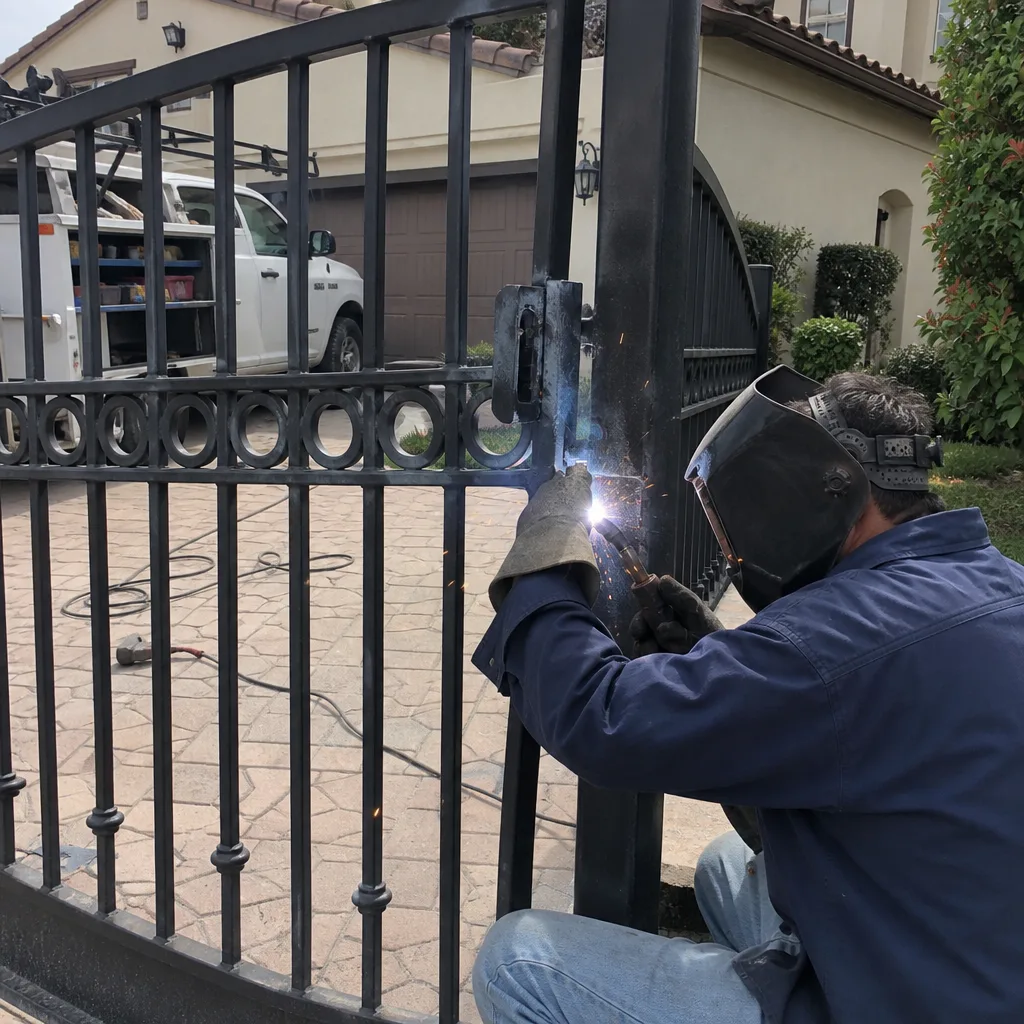
The control board is the least visible component on any gate system, and the one that talks the most. Every click, chatter, and silence is a diagnostic signal. Here’s what the sounds mean.
Relay chattering is a rapid clicking, five to twenty clicks per second, coming from the control board enclosure. It’s not the motor; it’s the relay that feeds power to the motor. Chattering means the relay coil is getting insufficient voltage to stay closed, so it opens and closes continuously. In Irvine this is often a failing transformer, a corroded terminal, or a solar-charged battery bank that’s dropped below the controller’s threshold. Relay chattering is the one warning sign we tell homeowners to treat as an emergency. Every chatter event arcs across the relay contacts, and the board will fail, usually within days, sometimes taking the transformer with it.
A single loud click with no movement means the relay engaged but the motor didn’t turn. That’s either a dead capacitor, a seized gearbox, or a motor winding that’s opened. The click tells you the board is doing its job. The problem is downstream.
No sound at all from the board when you press the remote means the board isn’t receiving the signal or isn’t receiving power. Before you call, check the outlet or breaker feeding the operator. In Irvine, many gate operators are on the same circuit as landscape lighting or pool equipment, and a tripped GFCI outlet on the side of the house is the single most common no-power cause we find. It takes ten seconds to reset, and we’d rather you not pay a service call for it.
A humming that lasts longer than five seconds without the gate moving is the motor trying to start. It’s either a bad start capacitor (common on older Elite and Ghost Controls operators in Irvine) or a mechanical bind strong enough to stall the motor. The start capacitor is cheap and the fix is quick if caught early. Let it hum for weeks, and the motor windings overheat and burn.
Safety Device Warning Signs: Photo-Eyes, Edges, and Loops
Safety devices are where gate repair intersects with legal liability. Under UL 325, which governs automatic gate operators, every gate sold and installed in the United States must have a primary and secondary entrapment protection system: typically a photo-eye beam across the gate opening and a reversing edge or safety loop. These devices fail in ways that are measurable, and they fail often because they live outside.
What to check:
- Photo-eye alignment. The photo-eye (the infrared beam that stops the gate if something crosses the path) has a transmitter and a receiver. Most have a small alignment LED that lights when the beam is acquired. If the LED blinks or stays dark, the beam is broken or misaligned. A 2-inch vertical misalignment is enough to drop the beam. When the photo-eye fails, the gate controller usually still opens the gate but will not close it automatically. That’s not a controller problem. That’s the safety system doing exactly what it was designed to do.
- Reversing edge wear. The reversing edge is the rubber strip along the leading edge of a swing or sliding gate. If you press on the edge and the gate doesn’t reverse, the internal contact strip has failed. On Irvine gates with full western afternoon sun exposure, we replace reversing edges at roughly a five-year interval. UV degradation hardens the rubber, and the internal switch stops making contact.
- Loop detector response. A vehicle loop is a coil of wire buried in the driveway that detects the metal mass of a car. When a loop fails, the gate either won’t open for a waiting car or won’t close after the car passes. A failed loop is usually invisible until you notice the gate staying open longer than it should. The loop itself rarely fails; the wire at the transition from the sawcut to the operator enclosure is usually where moisture gets in.
If your gate’s safety devices are not functioning, we recommend treating the gate as a manual gate until the devices are repaired. A gate that closes on a child or a pet is not a hypothetical in Irvine’s neighborhoods with young families. The repair is rarely expensive. The negligence is.
The Three Warning Signs Irvine Homeowners Dismiss as Normal
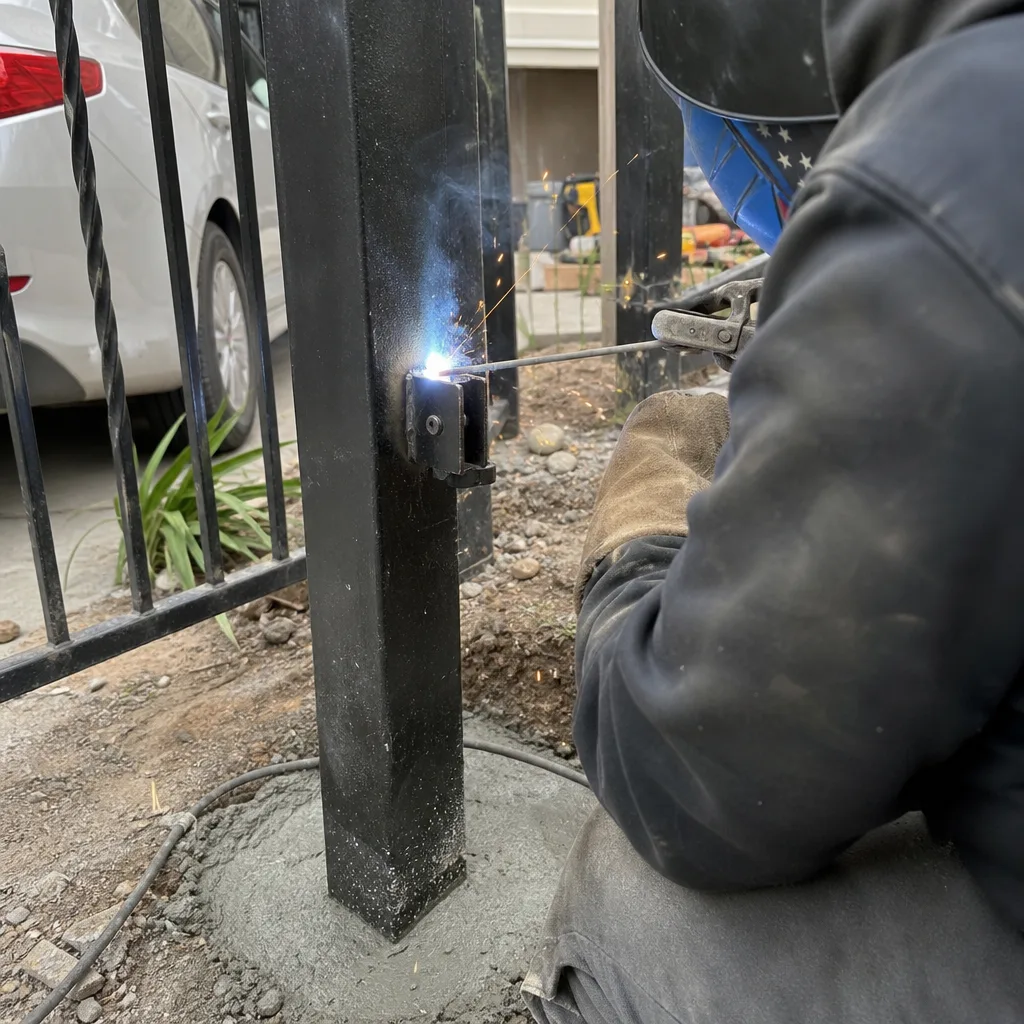
There are three symptoms we hear described as “oh, it’s always done that,” that are actually 30-day failure predictors. Here they are in order of how often we see them in Irvine.
- The two-second hesitation. The gate receives the command, pauses, then moves. Homeowners describe this as “it’s just slow.” It’s not. The pause is the start capacitor struggling to provide the surge current, or the gearbox overcoming initial inertia against a bind. Either way, the motor is repeatedly operating at the limit of its capacity. In our experience, a gate that hesitates two seconds before moving is within 30 days of either a capacitor failure or a mechanical seizure.
- The “normal” squeak. Squeaks are not lubrication requests. They are metal-to-metal friction signals, almost always at the hinge or the arm bracket. Lubricating a squeaking hinge without addressing the misalignment that caused the squeak simply drowns out the warning until the metal wears through. Gates should not squeak. A gate that squeaks is telling you the hinge pin and the hinge body are grinding on each other.
- The gate that reverses at the same spot every time. Homeowners describe this as “it’s temperamental.” It’s not. A gate that reverses mid-travel at the same position every cycle is hitting a resistance threshold that triggers the controller’s obstruction detection. It could be a tight spot in the track, a branch intruding into the swing arc, or a sagging leaf that binds on the latch post at exactly that point. The controller is working correctly. The gate is not.
The theme across all three: the gate is communicating through measurable behavior, but only if someone knows what to measure. That’s the reference this guide is meant to give you.
Photo Documentation Protocol: Baseline Evidence Before the Technician Arrives
Before you call anyone, we recommend a five-minute documentation pass. This is not because we distrust other contractors, though a Vance Gate Repair Irvine home visit always starts by reviewing whatever documentation you already have. It’s because a baseline record protects you from scope expansion. If a technician arrives and says “the hinge was fine when I got here,” your photo from yesterday says otherwise.
The protocol we recommend to every Irvine homeowner:
- Photograph the gate from the hinge side, full frame. Capture the entire gate, the post, and the operator arm. This is your structural baseline.
- Close up on each hinge, top and bottom. Get close enough that the gap between the leaf and the post is visible. This is your wear baseline.
- Photograph the operator with the cover on, then with the cover off if you can remove it safely. Never remove an operator cover with the power connected. If you can’t safely access it, photograph the exterior only. A photo of condensation inside the cover is diagnostic gold.
- Photograph the photo-eye units, both sides. Include a shot that shows whether the alignment LED is on. This is your safety baseline.
- Video the gate in one full open and close cycle, with audio. The sound file is half the diagnostic value. Ten seconds of video with audio can identify a seized roller or a grinding gearbox faster than any verbal description.
- Note the date, time, and weather conditions. In Irvine, winter rain changes gate behavior dramatically. A symptom that appears only after rain is a water intrusion problem, not a mechanical one. The date and weather context tells the technician that.
This is the same documentation habit Adrian Vance developed on commercial access-control sites starting in 2014, applied to residential gates. Every Vance Gate Repair visit ends with a photographed record of what was found, what was set, and what was installed, left with the homeowner and filed in the job record. Your baseline photos from before the call become the first page of that record.
Common Mistakes to Avoid
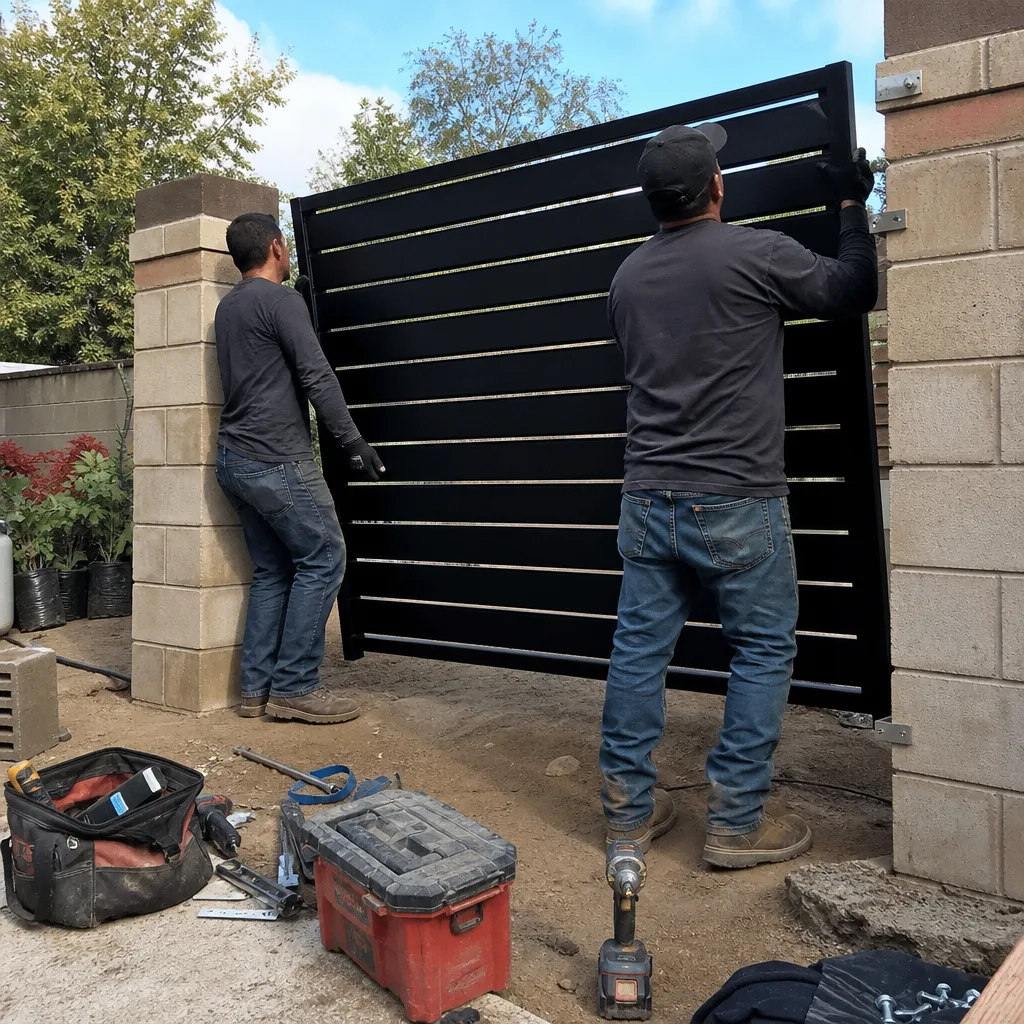
- Lubricating before diagnosing. If the gate is moving hard because a hinge is sagging, lubricant hides the friction temporarily and lets the wear continue silently. Measure first, lubricate second.
- Resetting the breaker without checking why it tripped. A gate operator that trips its breaker did that for a reason. In Irvine, that reason is often a failing capacitor or a water-damaged board. Reset once. If it trips again, do not keep resetting it.
- Ignoring a photo-eye warning light. The blinking alignment LED is telling you the safety system is offline. Driving your car through a gate with a dead photo-eye is a risk calculation, not a repair strategy.
- Waiting until the gate won’t open. A gate that’s stuck closed traps your car inside. A gate that’s stuck open leaves your property unsecured overnight. Both are emergencies. The repair before that point was not an emergency, and it was cheaper.
- Describing the problem in adjectives instead of measurements. “It’s slow” tells a contractor nothing useful. “It takes 18 seconds to open and the motor is hot after three cycles” tells us everything. The more precise you are, the less room there is for an inflated diagnosis.
- Replacing a motor without checking the mechanical load. A new motor on a binding gate will fail the same way the old one did. If a contractor quotes a motor replacement without measuring the hinge play or the track resistance, get a second opinion. Vance Gate Repair offers a free second opinion on any written estimate from another company. Bring the paperwork and we’ll review it at no cost.
When to Call a Professional
Call a professional if you observe any of these: relay chattering from the control board, a motor housing too hot to touch after five cycles, a gate that reverses at the same spot every cycle, a reversing edge that doesn’t reverse the gate when pressed, or any symptom that started after rain. These are not DIY-friendly situations, and several of them involve high-tension springs, live electrical connections, or heavy moving gates where a misstep can cause serious injury. A trained technician with the right tools can diagnose the exact component in one visit. Vance Gate Repair Irvine offers free estimates in Irvine; call (657) 258-2588 and a live person answers, any hour, any day.
Frequently Asked Questions
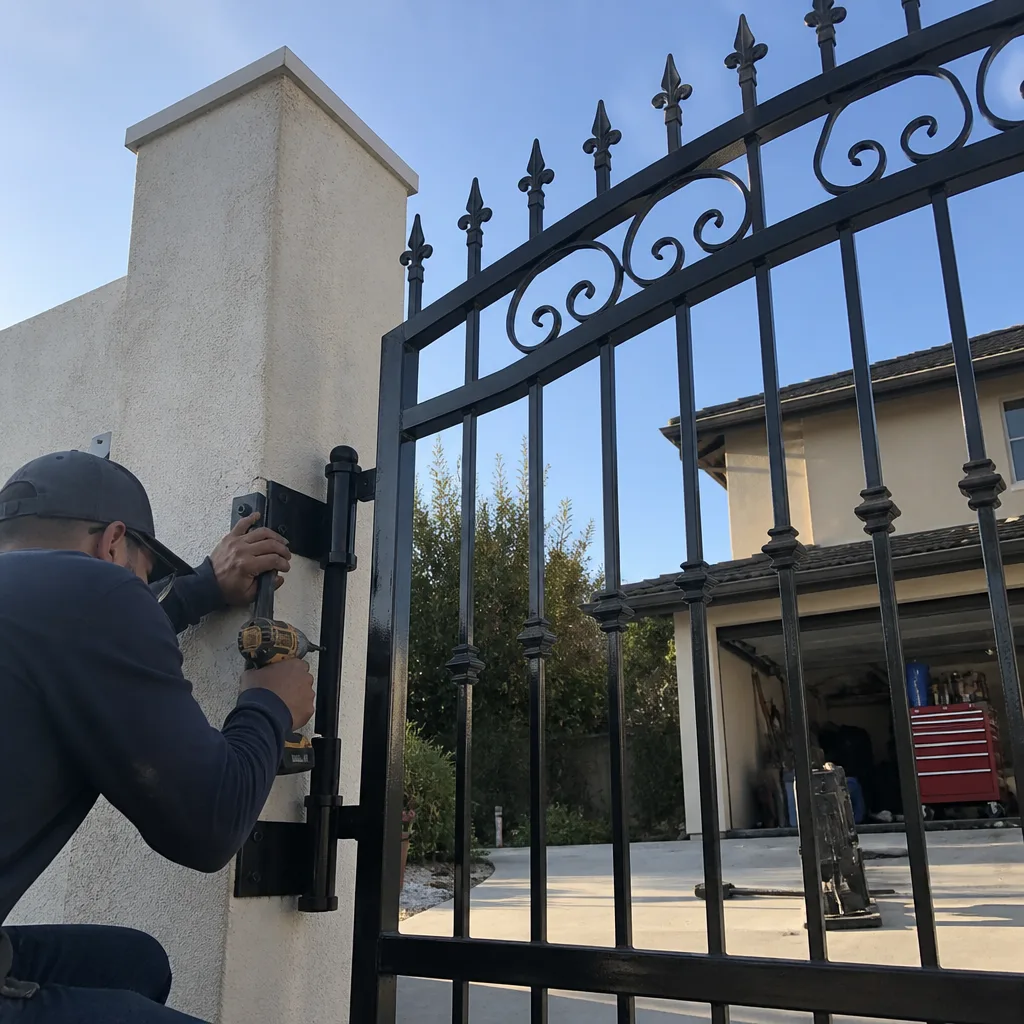
The measurable warning signs are: travel time over 15 seconds, a motor housing too hot to hold after five cycles, a two-second hesitation before movement, rhythmic thumping on a sliding gate (flat-spotted roller), relay chattering from the control board, and a photo-eye alignment LED that blinks or stays dark. Any one of these warrants a professional evaluation.
Gate repair in Irvine typically ranges from $90 for a hinge bushing replacement to $1,800 for a full operator replacement, with most repairs falling between $150 and $600. The cost is driven by which component has failed. A hinge service is a fraction of the cost of a motor replacement, which is why early diagnosis matters. Call (657) 258-2588 for an exact quote; estimates in Irvine are free and written before any work starts.
A hesitation of one to three seconds before the gate moves indicates the start capacitor is struggling to provide surge current, or the gearbox is overcoming initial resistance from a mechanical bind. Both causes put the motor at the limit of its capacity on every cycle. A gate that hesitates is usually 30 days from a capacitor failure or a mechanical seizure.
We service nine automation brands, including DoorKing, Elite, Mighty Mule, and Ghost Controls. If your motor is one of those four, we have parts and diagnostic experience specific to it in stock and in service history. We repair whatever motor is already on the property rather than steering you toward a replacement that isn’t necessary.
Yes, emergency repair visits are available in Irvine every day of the year. A live person answers the phone 24/7 at (657) 258-2588. Same-day service is available for urgent failures like a gate stuck open or closed.
Every Vance Gate Repair visit includes a written price delivered before any work begins, a documented photo record of what was found and what was set, and the part numbers of anything installed. That’s the Haven Standard: written scope, written price, and photographic evidence on every visit.
The Bottom Line
Gate failure is a process, not an event. It starts with a measurement drifting out of spec: a gate that takes 18 seconds instead of 12, a hinge with an eighth-inch of play, a photo-eye beam two inches out of alignment. Each of those measurements is observable today, before the failure and before the larger invoice. The reference points in this guide, the travel time, the temperature threshold, the 2-inch beam tolerance, the relay chatter sound, are the tools that let you see the warning signs for what they are, along with Seasonal Gate Repair Care for Irvine: Year-Round Homeowner’s Guide for ongoing maintenance. A gate in Irvine should move in 10 to 14 seconds, run cool, and make no sound except the motor’s steady hum. If yours doesn’t, you now know what it’s saying. Vance Gate Repair Irvine offers free estimates and a written price before any work starts; call (657) 258-2588 and a live person answers.
Written by Adrian Vance, Owner at Vance Gate Repair Irvine, serving Irvine since 2014.